


Project: design and development of the largest comprehensive Kurdish dictionary (Kurdika) – website and mobile app
Introduction
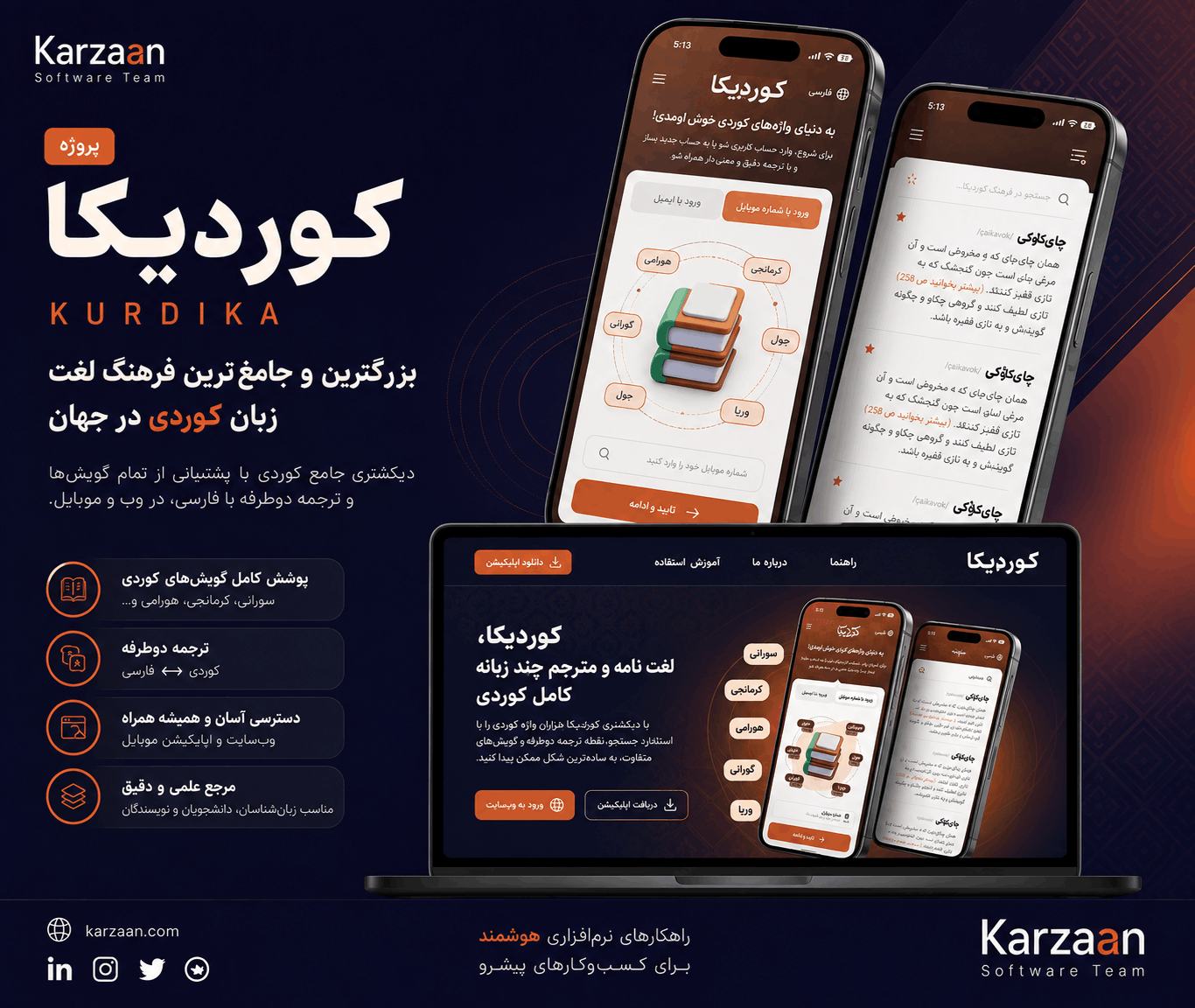
Kurdika (Kurdica) was designed and built by the Karzaan software team to create the largest and most comprehensive Kurdish dictionary in the world. Available on both the web and mobile, the platform brings all branches of the Kurdish language (including the Sorani, Kurmanji and Hawrami dialects, among others) together in one powerful dictionary and offers two-way translation between Kurdish and Persian.
Designed as a unique reference for linguists, students, writers and everyone interested in the Kurdish language and culture, the project combines deep linguistic knowledge with an advanced technical architecture and a smooth user experience.
Implementation process and key technologies
1. UI/UX design and front end
Custom design in Figma: after researching users’ needs (fast search, precise display of meanings, easy access to different dialects and a readable experience), Karzaan’s design team designed the user interface in Figma. Every element was designed for simplicity, accessibility and visual beauty in keeping with the rich Kurdish culture.
Web front end built with Next.js and Tailwind CSS: the Kurdika website was built with the Next.js framework (App Router). This enables server-side rendering (SSR) and static site generation (SSG), resulting in fast loading, a smooth user experience and significantly better SEO. Styling with Tailwind CSS gives the site a modern, responsive look that works on every device (mobile, tablet, desktop).
Mobile app built with Flutter: the Kurdika app was built with Flutter to deliver a consistent, smooth, high-performance experience on both Android and iOS. Thanks to Flutter, the app benefits from high speed, smooth animations and advanced offline capabilities.
2. Back end and database architecture
A powerful admin panel built with Yii2: all management processes (words, dialects, users, translations and content) are implemented with the Yii2 (PHP) framework. With its MVC architecture and built-in security features (such as protection against CSRF, XSS and SQL injection), the framework provides a secure, stable foundation for managing the project’s huge volume of content.
MongoDB: because of the great variety of data (words, roots, examples, dialects, morphological and syntactic structures) and the need for dynamic changes to the data structure, a NoSQL database (MongoDB) was used. This allows documents with varying structures to be stored, scales well and keeps complex search queries fast.
3. Integrated payment system (rial and foreign currency)
As a store and subscription platform, Kurdika needed a flexible payment system for users both inside and outside Iran. The Karzaan team built a smart payment layer that supports rial payment gateways (for Iranian users) as well as foreign-currency gateways (for international users). All transactions are processed with the highest level of security and encryption, and users can easily pay for premium content or monthly/annual subscriptions.
4. API-driven architecture and integration
A robust RESTful API layer connects the website (Next.js), the mobile app (Flutter) and the back end, enabling secure, fast and simultaneous data exchange. All requests are authenticated with JWT (JSON Web Tokens), and data is synchronized between platforms in real time.
Unique features and key modules
- Smart search engine: advanced search with filters by dialect, word root and usage type (literary, colloquial, scientific), with automatic display of meanings and examples.
- Support for every branch of Kurdish: words and expressions from all the main Kurdish dialects (Sorani, Kurmanji, Hawrami, Laki and more) in a single unified database.
- Two-way translation: accurate translation from Kurdish to Persian and from Persian to Kurdish.
- Dynamic content management: a custom admin panel for the Kurdika linguistics team to easily add, edit and remove words, update dialects and manage multilingual content.
- Offline access in the app: after downloading language packs, mobile users can use the dictionary without an internet connection.
- Subscriptions and payments: monthly/annual subscriptions and premium content via rial and foreign-currency payment gateways.
Results and added value
- The world’s largest Kurdish dictionary: by collecting words and expressions from every branch of the Kurdish language, Kurdika has become the largest Kurdish language reference in the world.
- A consistent experience on web and mobile: users can access this comprehensive dictionary anytime, on any device.
- Foreign-currency payments: the ability to serve international users and reach audiences outside Iran.
- High scalability: the technical architecture based on Next.js, Flutter and MongoDB allows the number of users and words to grow without performance loss.
- Preserving and spreading the Kurdish language and culture: the project is an effective step toward documenting, preserving and teaching the Kurdish language to future generations and everyone interested in this rich culture.
Conclusion
The Kurdika project demonstrates the Karzaan team’s ability to combine the latest technologies (Next.js, Flutter, Yii2 and a MongoDB database) with specialized linguistic knowledge to create a unique and impactful platform. It shows how a cultural idea, backed by an advanced technical architecture and user-centered design, can become a valuable global digital product that crosses geographic borders.
To read more about the technologies used and how such platforms are designed, see these articles on the Karzaan blog:
- Custom app or ready-made app? A guide to the right choice for your business
- Enterprise mobile app design: a complete guide from scratch to launch (in Persian)
- Building apps with AI: best practices and tools (in Persian)
- The benefits of mobile app design: a leap toward success (in Persian)
- What is app design? The traits of a successful app (in Persian)
- Website or app? Which one is more profitable? (in Persian)