


.png)
Deciding to launch a mobile app is one of the most important steps a business or organization takes on its way to going digital. But right after that decision comes a bigger question: “Should we build a custom app or use a ready-made platform?” As with the question of a custom website versus a ready-made template, the right answer here depends on your business’s specific situation, not a fixed rule. In this article we look at the fundamental differences between the two approaches, the deciding factors, the common mistakes organizations make and practical criteria for deciding, so you can make this important choice with a clearer view.
What is a ready-made app?
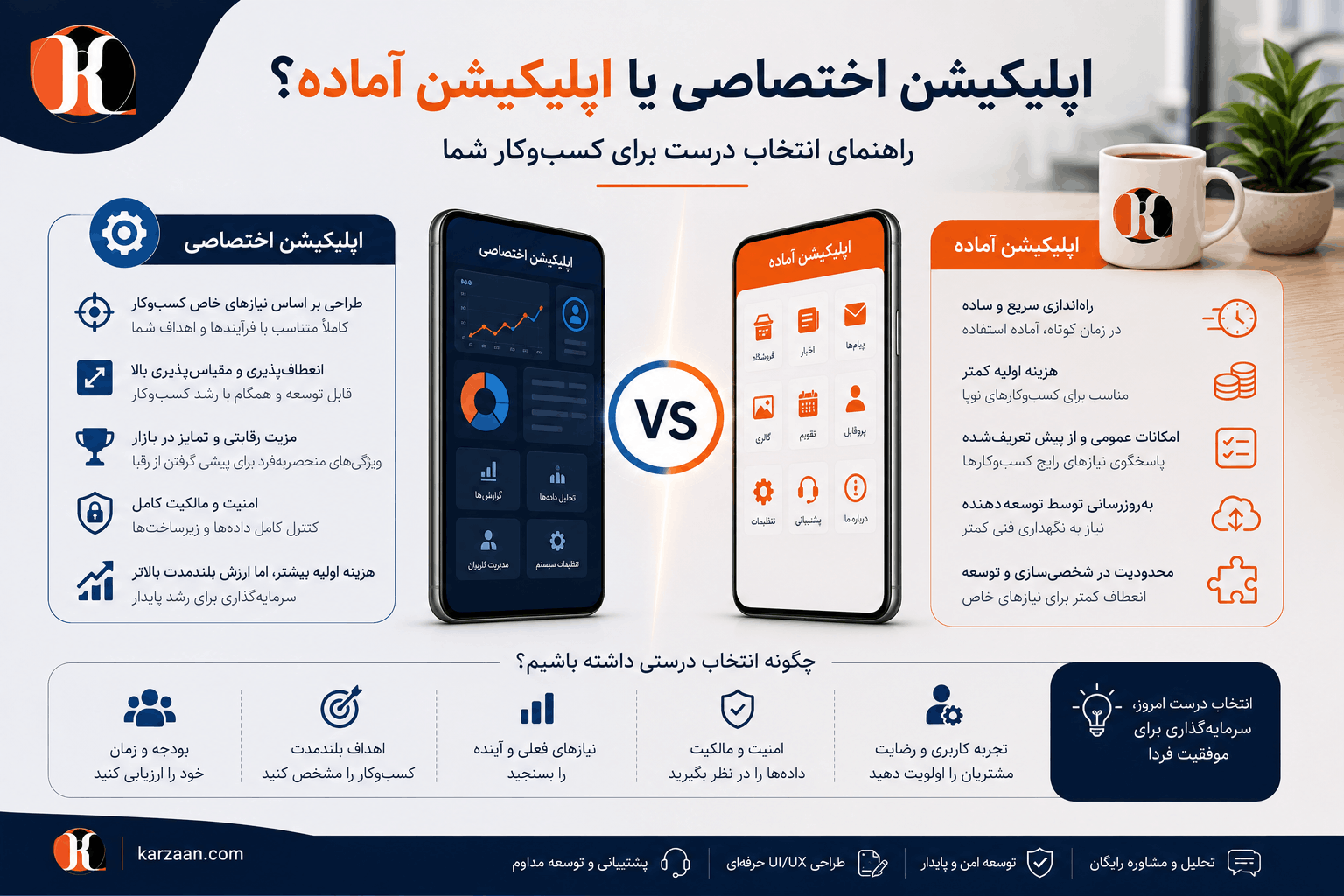
Ready-made apps (sometimes called no-code or low-code) are platforms or tools that let businesses launch a mobile app without a dedicated development team. They usually include a visual interface for building screens, predefined features (forms, maps, a shopping cart and so on) and ready-made hosting infrastructure.
Some businesses also take “ready-made app” to mean buying a complete product off the market (such as a ready-made store app, booking app or service delivery system) and customizing only the brand and content.
What is a custom app?
A custom app is designed and developed from scratch, based exactly on your business’s needs, processes and visual identity. As we explained in detail in the steps of designing an enterprise mobile app (in Persian), the process starts with user research and continues with ongoing support and improvement.
Key comparison
Criterion |
Custom app |
Ready-made app |
|---|---|---|
Initial cost | Higher | Lower |
Time to launch | Slower | Faster |
Customization | Complete and unlimited | Limited to the platform’s features |
Differentiation from competitors | High | Low (competitors use the same platform) |
Integration with internal systems | Complete | Limited or paid separately |
Scalability | High | Limited to the platform’s plans |
Code ownership | Entirely yours | With the provider |
Long-term cost | More stable | Rising (monthly/yearly subscription) |
Dependence on the provider | None | High |
Advantages of a custom app
1. Real differentiation from competitors
When your competitor uses the same ready-made platform, end users get two near-identical experiences with only the logo and colors changed. A custom app lets you design a completely unique experience that comes straight from your brand’s values.
2. Your real processes, not predefined ones
Ready-made platforms are designed for a hypothetical “average user”. If your business process differs even slightly from that model, you’ll constantly be working around the system’s limits. A custom app is designed for exactly how you actually work.
3. Full integration with existing systems
If your organization uses internal systems such as a CRM, an ERP or an enterprise LMS (in Persian), a custom app can be designed from the start to integrate fully with them. On ready-made platforms, these integrations are usually limited, incomplete or expensive.
4. Full ownership and independence
A custom app belongs to you. If a ready-made platform’s provider raises its prices, changes its policies or shuts down altogether, your business is at serious risk. That risk doesn’t exist with a custom app.
5. Security you control
On ready-made platforms, your users’ data is stored on a third party’s servers. With a custom app, you can define exactly the hosting, how data is encrypted and the level of security control, which is vital for organizations with sensitive data (such as banking, healthcare or government apps).
6. A user experience optimized for your audience
Custom UX design means every interface element, every flow and every system message is designed precisely for the behavior and expectations of your specific users. That level of optimization isn’t possible on any ready-made platform.
Advantages of a ready-made app
1. Speed to market
If you need to be present quickly, for example to test an idea or meet a temporary need, ready-made platforms can get you launched within days or weeks.
2. Lower initial cost
For early-stage businesses that don’t yet have a stable revenue stream, a ready-made platform with a lower initial cost can be a more sensible start.
3. Automatic updates
The platform provider usually handles new features, bug fixes and security updates itself, with no need for an in-house technical team.
4. Technical support included
Most ready-made platforms have a support team you can contact when something goes wrong.
Common mistakes businesses make
Mistake 1: deciding on initial cost alone
This is the most common mistake. As we also explained in the cost of an enterprise LMS (in Persian), the comparison should be based on the total cost of ownership over the long term, not the initial cost. As users and features grow, a ready-made platform’s monthly subscription can exceed the cost of developing a custom app within three to five years.
Mistake 2: choosing a ready-made platform for complex processes
If your business process is multi-step, personalized or depends on specific business logic, you’ll probably hit the platform’s limits within a few months. Redesigning and moving to a custom app at that point costs more than starting right in the first place.
Mistake 3: ignoring vendor lock-in
When all your data, processes and users live on a closed ready-made platform, switching platforms later becomes very hard and expensive. This risk should be part of the decision from the start.
Mistake 4: building a custom app without user research
A custom design without a real understanding of users’ needs and behavior leads to an expensive app that few people use. The checklist we gave in the steps of designing a mobile app (in Persian) is designed precisely to prevent this mistake.
Mistake 5: ignoring future needs
Many businesses choose an app only for today’s needs. The right question is: “If our users grow tenfold, if we need a new feature or if we want to integrate with a new system, how will this platform respond?”
Decision criteria: which option suits you better?
Consider a custom app if:
Your business process is complex or unique. If what you want the app to do involves specific business logic that a simple form or standard flow can’t cover, a custom app is the only real option.
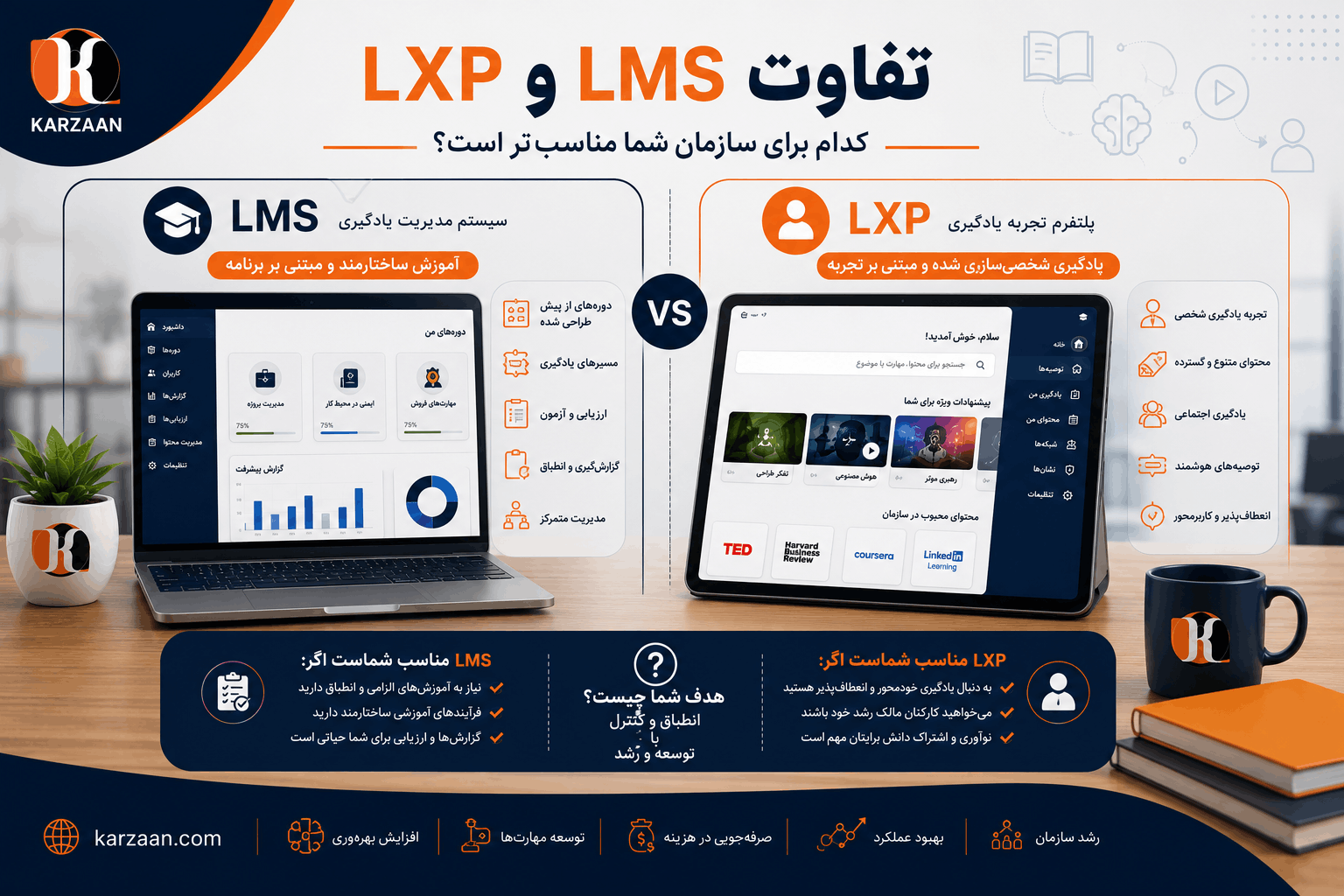
You need integration with internal systems. From CRM and ERP to a learning management system (in Persian) or a combined LMS/LXP platform (in Persian), if the app has to talk to existing systems, a custom architecture makes that integration possible without limits.
Your data and security are sensitive. For organizations that work with financial, medical, educational or corporate data, full control over where data is stored and how it is encrypted is vital.
Visual competition matters in your market. If brand experience matters to your customers and you want to stand out from competitors, custom UX design is a justifiable investment.
You plan for long-term growth. If you expect your business to grow significantly, a custom, scalable architecture from the start removes the cost of a future redesign.
Consider a ready-made app if:
You’re at the proof-of-concept stage. If you’re not yet sure your app will work in the market, starting with a ready-made platform and testing the idea at the lowest cost makes sense.
Your needs are entirely standard. If you need a restaurant app, a simple store, a blog or a basic online presence with no special process, a ready-made platform is enough.
You have no technical team. If there are no developers on your team and you don’t want to work with an outside company, no-code tools can be a good temporary option.
Your need is temporary. For events, seasonal campaigns or projects with a fixed lifespan, a ready-made platform makes more sense.
A hybrid approach: start ready-made, move to custom
One of the smartest strategies some businesses use is this two-phase path:
Phase one: launch on a ready-made platform to enter the market quickly, collect data on real user behavior and prove the business model.
Phase two: with precise knowledge of users’ real needs (not initial assumptions), design a custom app that implements exactly what you’ve learned.
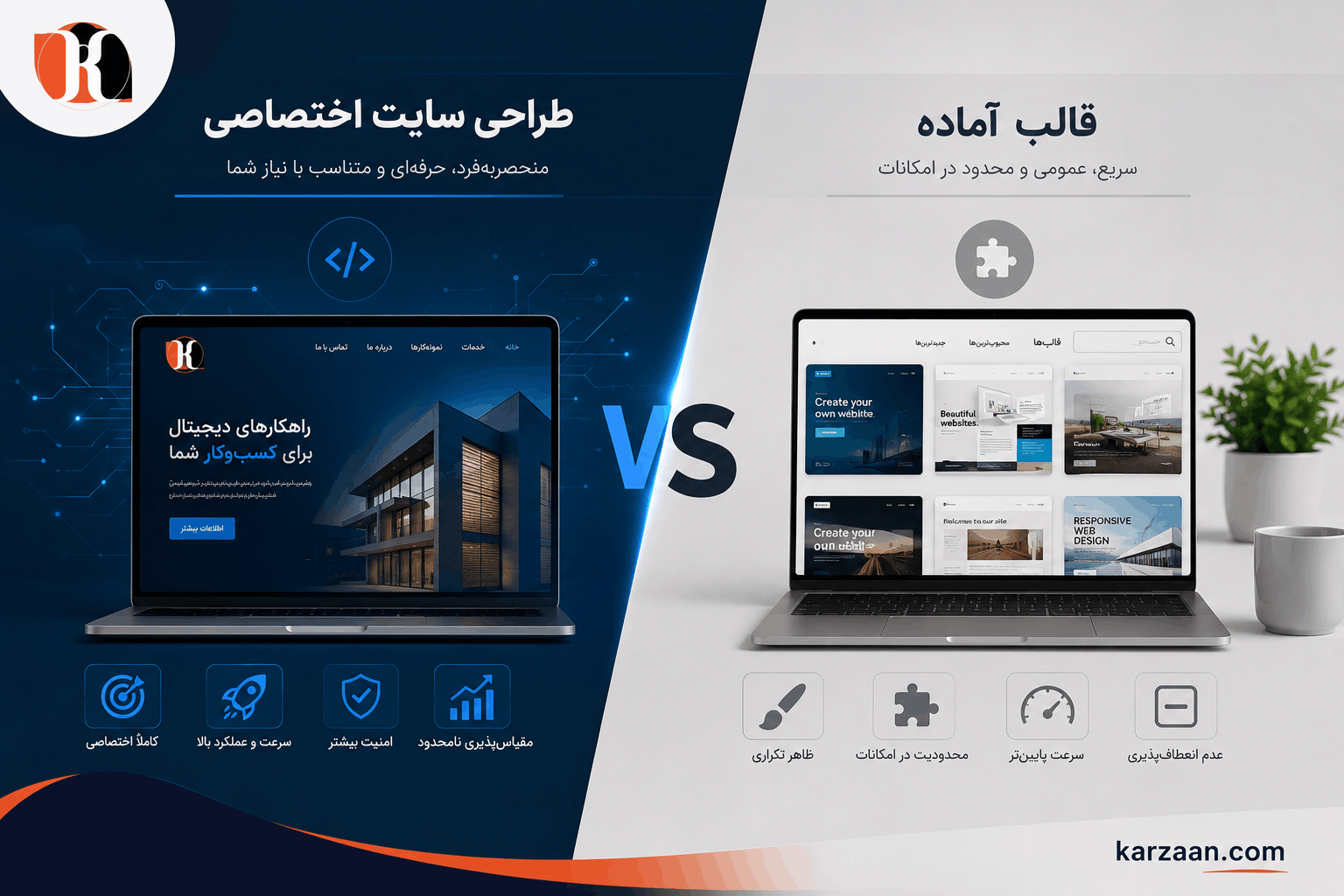
This is the same approach we recommended in custom website design versus a ready-made template: a smart start, not a perfect one.
Enterprise apps: a special case that is usually custom
There is a completely separate category that almost always needs a custom app: internal enterprise apps. These are apps designed for employees (not the general public), such as warehouse management, field reporting, attendance or mobile access to the corporate learning system (in Persian).
In this category, ready-made templates usually don’t fit, and even if they did, the security of corporate data and the need to integrate with internal systems make a custom app the only sensible choice.
How the right platform choice affects your overall digital strategy
This decision shouldn’t be made in isolation. Your mobile app is part of a larger digital ecosystem that also includes your corporate website, your enterprise systems and your learning tools. The decision you make for the app today directly affects which integrations will be possible in the future.
For example, if your organization implements a combined LMS/LXP platform (in Persian) today and later wants a mobile app through which employees can access learning content, a custom architecture on both systems makes that integration painless. But if both are built on different ready-made platforms, the integration is either impossible or very expensive.
The same applies to the app’s relationship with your corporate website: when both are built on a custom architecture, creating a seamless experience for users (such as single sign-on or data synchronization) is much simpler.
Checklist before the final decision
Before choosing between a custom and a ready-made app, ask yourself these questions:
- Can standard templates cover my business process?
- Do I need integration with existing internal systems?
- Is the data stored in the app sensitive?
- Do my competitors use the same ready-made platforms?
- Do I expect significant growth for my business?
- What will the total cost of ownership be over three to five years with each approach?
- What happens to my business if the ready-made platform’s provider shuts down?
What is true for an LMS is true for an app
In the checklist for choosing an LMS company (in Persian) we explained that choosing the developer matters more than the product itself. The same rule applies to mobile apps: even if you decide to build a custom app, choosing the right delivery team, one that takes user research seriously, plans realistic phases and has experience integrating with enterprise systems, determines whether the investment pays off.
Mobile apps and learning systems: a concrete example
One area where the “custom or ready-made” question matters even more is combining a mobile app with corporate learning systems. Imagine an organization that has implemented a combined LMS/LXP platform (in Persian) and wants its employees to access learning content on mobile too. In this scenario:
If both the LMS/LXP and the mobile app are custom, full integration is possible: single sign-on (SSO), real-time synchronization of learning progress, notifications for expiring courses and even offline use of learning content. This is exactly the level of experience we mentioned in the difference between LMS and LXP: an experience that keeps users engaged with the learning system.
If the mobile app is a ready-made platform, you can probably show a basic list of courses, but none of those deep integration features can be implemented.
Technical questions to ask the delivery team
If you decide on a custom app, be sure to raise these technical questions in the first meetings:
- Which development framework? (Flutter, React Native or native?) The difference between these choices in cost, speed and final quality is significant.
- What is the API architecture? Has integration with existing systems been built into the architecture from the start?
- What is the offline solution? If users work without internet access, how will that be handled?
- How do updates work? Do updates need App Store approval, or can internal distribution be used?
- How is testing done on real devices? Not just in a simulator.
How the choice of app affects user retention
An often overlooked aspect of this comparison is the effect of user experience quality on retention. Industry data shows that users abandon apps with a poor user experience within the first week after installing them. For B2B and enterprise apps the figure is a little better, because users “have to” use them, but even then the quality of the experience directly affects productivity, job satisfaction and, ultimately, real adoption of the system.
Ready-made apps usually do worse here, because their UX is designed for “the average of all customers”, not for your specific users.
Summary
There is no single answer to the question “custom or ready-made app?”. But there is a general principle: the more complex your business process, the more sensitive your data, the greater your need for integration and the longer your growth horizon, the more sensible a custom app becomes. On the other hand, for a quick start, testing an idea or entirely standard needs, a ready-made platform can be a good starting point. The Karzaan team has experience with both paths and can give you precise, candid guidance based on your business’s real situation.