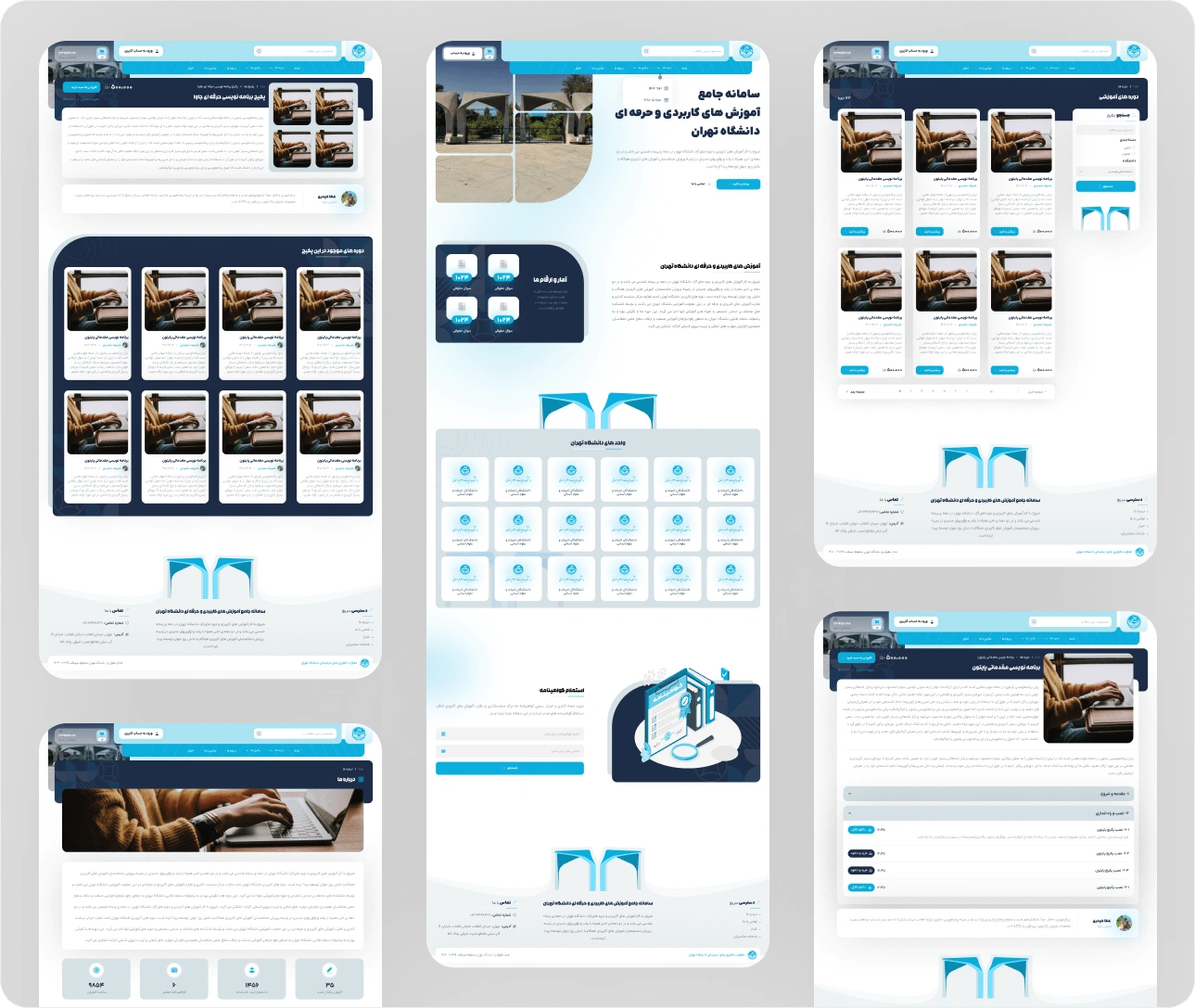



University of Tehran comprehensive applied training system
A technical masterpiece by Karzaan Software Group
Summary
Using the latest web technologies, Karzaan Software Group designed and built the University of Tehran’s comprehensive applied training system (https://eec.ut.ac.ir) as an integrated learning ecosystem. By combining NextJS, NodeJS and Yii2, this advanced platform meets the complex needs of course management, online classes, smart revenue sharing and advanced assessment in an innovative way.
Technical architecture: an optimal mix of modern technologies
Layer |
Technology |
Description |
|---|---|---|
Frontend |
NextJS 13 |
Server-side rendering (SSR) for advanced SEO + performance optimization |
Web services |
NodeJS (Express) |
42 RESTful services with JWT authentication |
Admin panel |
Yii2 (PHP) |
MVC architecture for managing complex roles |
Database |
MongoDB 6.0 |
Flexible storage of learning data |
Infrastructure |
Docker + Nginx |
Containerized deployment with load balancing |
The system’s core functions
1. Course management and smart revenue sharing
- Faculty contract mechanism:
- Hierarchical access levels (faculty > agent > instructor)
- Automatic calculation of revenue shares
- A dedicated panel for agents:
- Uploading courses with custom pricing
- Real-time reports on sales and revenue shares
2. An integrated online learning ecosystem
Module |
Key capabilities |
|---|---|
Adobe Connect |
Automatic classroom creation with SSO authentication |
Instructor panel |
Session scheduling + uploading learning materials |
Learner environment |
Access to session recordings + taking exams |
Notification system |
Email/SMS alerts for class events |
3. A comprehensive learning content system
- Hierarchical structure: course > week > session > {video, assignment, quiz}
- Smart presentation:
- A video player with variable playback speed
- PDF viewer with annotation support
- Downloading materials as a compressed package
4. An advanced exam builder
- Question types:
- Multiple choice (single or multiple answers)
- Descriptive (short/long answer)
- File upload (for projects)
- Professional features:
- Flexible exam scheduling
- Automatic report cards with analytical charts
- Cheating detection through activity monitoring
Technical innovations
1. A microservice architecture for financial transactions
2. Advanced design patterns in the admin panel (Yii2)
- Modular structure
- RBAC (Role-Based Access Control):
- 8 access levels based on organizational roles
3. Performance optimization in NextJS
- Techniques used:
- Automatic route-based code splitting
- Data preloading with getServerSideProps
- Caching API responses in Redis
Key deployment figures
- 3,000+ active courses
- 1,500+ concurrent users at peak traffic
- <800ms average API response time
- Multiple revenue-sharing models supported
Conclusion: a transformation in university education
With its multi-layer architecture and modern technologies, the University of Tehran’s EEC system has not only transformed the university’s e-learning infrastructure but, through its smart financial system, has also created a new model for managing learning resources. The smart combination of NextJS for a dynamic frontend, NodeJS for high-traffic services and Yii2 for managing complex roles is a successful model for the country’s higher education systems.
Proudly developed by Karzaan Software Group, the project shows that Iranian technical teams can build world-class systems.
To learn about learning systems and how AI is used in them, read these articles on the Karzaan blog:
- Personalized learning for organizations (LXP)
- Custom learning management system (LMS) design: a complete guide for organizations (in Persian)
- LMS vs. LXP: which is right for your organization?
- Checklist for choosing an LMS design company: questions to ask before signing (in Persian)
- Enterprise LMS cost: a full breakdown by features and project scope (in Persian)
- LMS or LXP? Why leading organizations choose both (in Persian)