


.png)
If you’ve been familiar with learning management systems (LMS) for a while, you’ve probably been hearing another name a lot lately: LXP, or Learning Experience Platform. Many corporate learning managers confuse the two or assume an LXP is simply an updated LMS, but they have completely different philosophies of learning. In this article we look at the main difference between the two platforms, see which kind of organization each suits, and answer whether you have to choose one or they can work side by side. For more detail and to see the operational architecture of this combined approach, read Karzaan’s complete LXP page.
A quick reminder: what is an LMS?
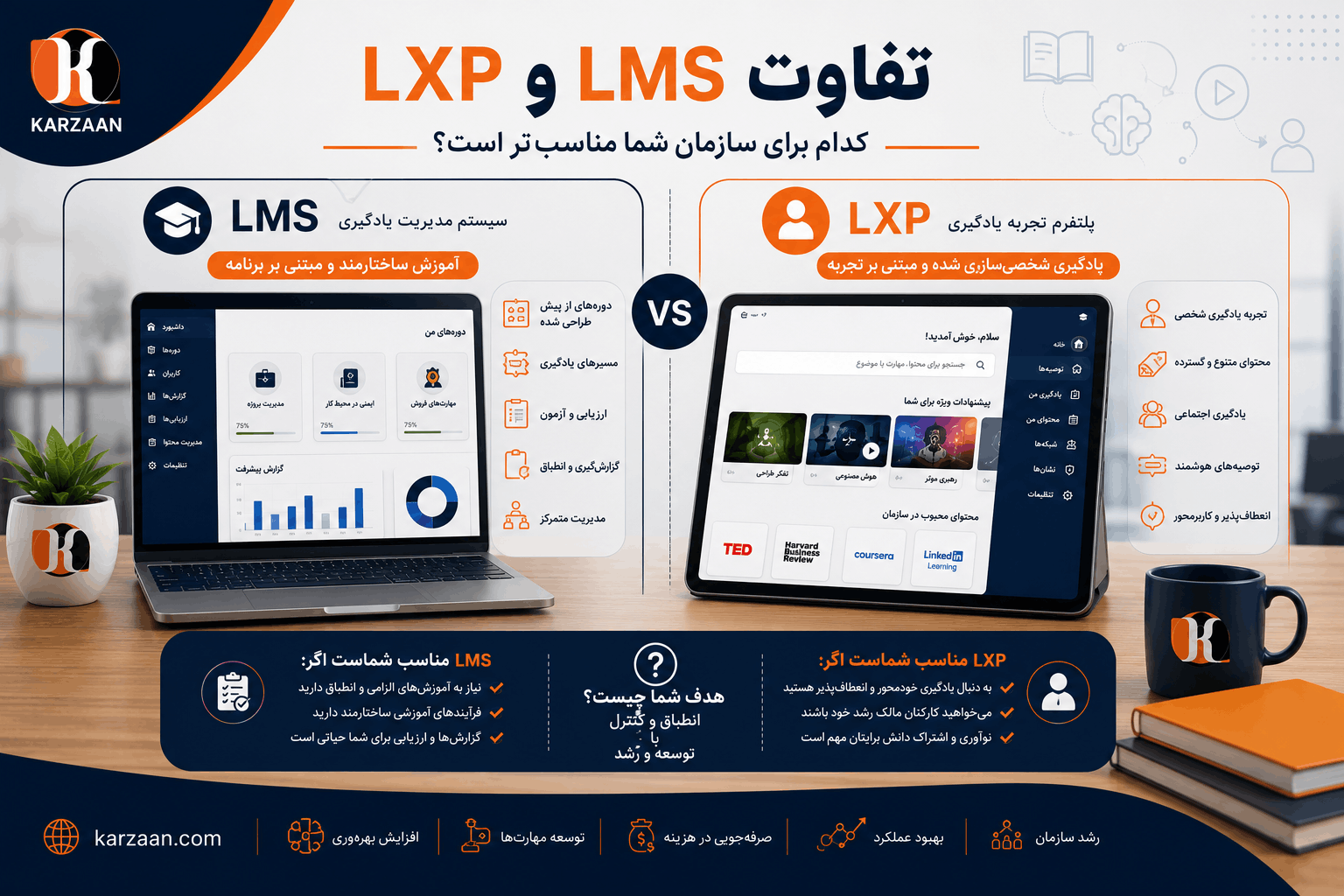
An LMS, or Learning Management System, is a platform for managing and controlling corporate training. The learning manager defines courses, assigns them to employees, tracks training requirements and reports on who has or hasn’t completed which course. The LMS’s main focus is on compliance, tracking and centralized content management.
What is an LXP?
An LXP, or Learning Experience Platform, takes a different approach: instead of assigning the same path to everyone, it focuses on a personalized learner experience. By analyzing each person’s behavior, job role, current knowledge and even learning patterns, an LXP suggests content that fits them, much like content recommendation platforms (such as video suggestions on streaming services), but for corporate learning.
In the new generation of LXPs, AI plays a central role in this personalization: from suggesting the next piece of content based on a person’s performance to generating summaries or tests tailored to each learner’s weak points.
Key comparison of LMS and LXP
| Criterion | LMS | LXP |
|---|---|---|
| Core philosophy | Managing and controlling training | A personalized learning experience |
| Learning path | Predefined by the manager | Dynamic and tailored to each person |
| Role of AI | Usually limited or absent | Central to personalization and content suggestions |
| Main user | The learning manager / HR | The learner |
| Best for | Mandatory, compliance and certification training | Continuous, self-directed skill development |
| Reporting | Focused on course completion and requirements | Focused on engagement, behavior and personal growth |
| Content source | Usually the organization’s internal, formal content | A mix of internal, external and user-generated content |
Why does this difference matter for your organization?
This difference isn’t just a theoretical or technical debate; it directly affects the return you get on your investment in corporate learning. If your organization’s main priority is making sure mandatory training gets done (such as safety training, rules and regulations or onboarding), an LMS, with its focus on control and tracking, is the right choice. But if your goal is continuous skill development and more motivation for self-directed learning (especially in knowledge- or technology-driven organizations), an LXP can have a far greater impact.
Why is the shift from LMS to LXP happening?
Several parallel trends have pushed the corporate learning industry toward the LXP:
1. Falling engagement with one-size-fits-all learning paths
When every employee sees the same learning path regardless of their role and knowledge, engagement and completion rates usually drop. Personalization targets this problem directly.
2. Changing expectations of digital experiences
Employees who use personalized platforms in everyday life (such as content suggestions tailored to their taste) expect a similar experience from their organization’s learning system. A static interface that is the same for everyone doesn’t meet that expectation.
3. Rapid progress in AI analysis of learner behavior
Recent advances in AI have made it far more practical and accurate than before to analyze each learner’s behavior, strengths and weaknesses and suggest suitable content.
4. The need for continuous learning in fast-changing environments
In industries where the necessary knowledge and skills change quickly (such as technology, sales and digital marketing), a fixed, uniform learning path soon becomes outdated. By suggesting dynamic, up-to-date content, an LXP keeps pace with that change better.
The role of AI in the new generation of LXPs
What sets today’s LXPs apart from earlier ones is the use of AI agents to perform tasks that used to be done manually or by fixed rules. Some of these functions are:
- Suggesting a personalized learning path: analyzing a person’s performance and role to suggest the next piece of content
- Generating summaries and test questions from content: cutting the time needed to prepare assessment content by hand
- Identifying learners’ weak points: analyzing test answers to find the topics a person struggles with and suggesting remedial content
- Answering learners’ questions (a virtual tutor): helping learners in the moment of learning, without waiting for a human instructor to reply
Do we have to choose between an LMS and an LXP?
This is one of the most common misunderstandings. In reality, many leading organizations use an LMS and an LXP side by side, as complements rather than replacements:
- The LMS handles mandatory, compliance and certification training and formal reporting (topics that need precise, uniform control)
- The LXP focuses on continuous skill development, self-directed learning and a personalized experience (topics that need more motivation and engagement)
In other words, the LMS guarantees “what you need to know”, and the LXP offers “what you want to know” in a more engaging way.
Checklist: which option suits your organization better?
To help you decide, answer these questions:
- Is your main priority making sure mandatory and legal training is completed? → Go for an LMS
- Do your employees need continuous learning and skill updates in a fast-changing environment? → Go for an LXP
- Are completion rates in your current system low, with employees not engaging enough? → An LXP’s personalization may be the solution
- Do you need precise reporting for audits or legal requirements? → This capability is stronger in an LMS
- Is your organization aiming for a culture of continuous, self-directed learning, not just periodic training? → An LXP fits that goal better
If you answer “yes” to most questions in both groups, the best path is probably to combine both platforms as complements.
Benefits of a combined approach (LMS + LXP)
Organizations that use both platforms in an integrated way usually see these benefits:
- Full coverage of both compliance needs and skill development needs
- Higher employee satisfaction and motivation through a personalized experience, alongside management’s assurance that mandatory training gets done
- Richer data for performance analysis, because both formal behavior (course completion) and informal behavior (searching, engaging, choosing content) are recorded
- A gradual shift in organizational culture from “compulsory training” to “continuous, self-directed learning”
Challenges of implementing a combined approach
Implementing both platforms at once without proper planning can be challenging:
- User confusion with two separate interfaces: if employees have to switch between two separate systems, the user experience suffers. The solution is a single point of entry (single sign-on) and, where possible, a single user interface.
- Duplicated content management: without proper integration, content may be stored and updated in two separate systems. The solution is a shared content source that both platforms use.
- Scattered data and reporting: if LMS and LXP data stay in two separate systems, a complete analysis of learner performance becomes difficult. Data integration has to be part of the technical architecture from the start.
These challenges are exactly why a custom design of these platforms (instead of using two different off-the-shelf products separately) can be a significant advantage: it is designed from the start for full integration.
The future: toward a single smart platform
The industry is moving toward a point where the line between LMS and LXP fades, and new-generation platforms offer both approaches (control and management alongside smart personalization) in a single environment. In this model, the learning manager still has the control and reporting needed for organizational requirements, while the learner gets a personalized, AI-based experience, without switching between two separate systems.
A hypothetical scenario to make the difference concrete
To see the difference in practice, consider a hypothetical scenario (not a specific real project): an organization with several departments (sales, production, IT). In the first case, relying only on an LMS, every employee sees the same standard “introduction to our products” course in the same way, whether they work in sales or IT. The result: sales staff skip much of the irrelevant technical content, and IT staff are unhappy with how shallow the sales-oriented parts are.
In the second case, with an LXP layer, the system shows each group the relevant parts of the same course with different depth and emphasis based on each person’s job role: the sales team focuses on the product’s selling points and the IT team on the technical details of implementation. Meanwhile, the formal requirement to complete the course (for reporting to management) is still tracked and recorded through the LMS. This is exactly the complementary approach described above.
How content strategy differs between an LMS and an LXP
Another important difference that gets less attention is the kind of content each platform works best with:
In an LMS, content is usually formal, structured and pre-approved by the learning department: complete courses with defined chapters, a final test and a certificate.
In an LXP, content can be much more varied and smaller (microlearning): a short five-minute video, an article, an internal podcast or even content created and shared by employees themselves (not just the formal learning department). This approach turns learning from a formal, occasional event into a natural, everyday activity in the flow of work.
That’s why, if your organization is planning an LXP, it should plan from the start for producing small, varied content (not just long, formal courses); otherwise, even the best personalization engine won’t have enough content to make varied suggestions.
Measuring LXP success (versus LMS metrics)
Just as an LMS and an LXP have different philosophies, the metrics for their success differ too:
Common LMS metrics:
- Completion rate of mandatory courses
- Percentage of employees who completed legal/compliance requirements on time
- Scores on formal tests
Common LXP metrics:
- Rate of voluntary (non-mandatory) visits to learning content
- How varied the content each user consumes is
- How often users return to the platform over a period of time (a measure of ongoing engagement)
- Accuracy of the system’s suggestions (do users actually consume the suggested content?)
If an organization uses only LMS metrics to evaluate an LXP, it will probably wrongly conclude that the investment “failed”, when in fact it simply chose the wrong yardstick.
Change management: preparing your culture for the move to an LXP
The technical implementation of an LXP is only half the journey; the other half is preparing the organization’s culture to embrace self-directed learning. A few key points:
- Communicate the purpose of the change clearly: employees should know why the change is happening and what it offers their personal and career growth, not just that “a new system has been installed”.
- Support from middle managers: if direct supervisors don’t encourage use of the platform in their team’s daily work, adoption will stay low.
- Start with a pilot group: like any other technical change, starting with a smaller department and expanding gradually reduces risk.
- Continuous feedback from early users: the accuracy of AI suggestions usually needs improvement at first; feedback from real users is the fastest way to improve it.
Organizations that get the most value from an LXP
Although an LXP can benefit a wide range of organizations, its value shows most clearly in these situations:
- Organizations with a large volume of varied, scattered learning content
- Organizations in fast-changing industries (technology, digital marketing, financial services)
- Organizations whose workforce is very diverse in job roles and knowledge levels
- Organizations that have already faced low engagement or completion rates with a traditional LMS
A general classification of the AI agents common in the LXP industry
As a general overview (not a presentation of a specific architecture, which is covered in full separately), AI agents in leading LXPs usually fall into one of these broad groups:
- Content curation agents: collect and categorize relevant content from different sources (internal and external) based on each learner’s needs.
- Skill gap analysis agents: identify learning gaps by comparing a person’s current skills with the requirements of their role or future career path.
- Conversational agents (a virtual tutor): let learners ask questions conversationally in the moment of learning and get an immediate answer.
- Motivation and engagement agents: analyze user behavior patterns to work out the right time and way to remind or encourage people to keep learning.
- Career path agents: take a longer view, tailoring learning suggestions not only to the current role but to the person’s likely career path in the organization.
Each organization’s LXP can implement a different combination of these groups, suited to its own needs and culture, which is exactly why custom design offers a significant advantage over a generic off-the-shelf platform.
Data and privacy considerations in an LXP
Because an LXP needs deeper analysis of behavior, performance and even individual learning patterns to personalize, privacy is more sensitive than in a traditional LMS. Organizations should address these points from the design stage:
- Being transparent with employees about what data is collected and how it is used
- Keeping data used to personalize learning separate from data that might be used for performance evaluation (such as promotions or bonuses), so learners can learn freely without fear of judgment
- Setting clear access levels for different managers to learners’ individual data
- Considering where data is stored, especially for organizations with specific legal requirements
Notes on implementation planning (without focusing on cost)
Setting cost aside (which we covered in a separate article), there are a few practical points for planning an LXP implementation:
- Start with a limited scope: instead of rolling out to the whole organization at once, starting with one department or one learning topic allows faster learning and correction.
- Prepare varied content before launch: without enough varied content, even the most advanced personalization engine can’t offer valuable suggestions.
- Define a continuous improvement process: the accuracy of AI suggestions improves over time as more feedback comes in, so expecting “perfection from day one” isn’t realistic.
How can an LXP help employer branding?
A less noticed benefit of an LXP is its effect on how current and future employees see the organization. An organization that uses a modern, personalized, AI-based learning platform sends a clear message to its workforce (especially younger generations, who are more attuned to technology): this organization invests in its employees’ personal growth, not just in meeting minimum training requirements. This can also help attract and retain skilled people.
Common mistakes when choosing between an LMS and an LXP
Mistake 1: choosing based on how new the technology is, not real needs
Many organizations move toward an LXP simply because it seems “newer” or “smarter”, without examining their real needs, when their main priority may still be control and compliance, which an LMS handles better.
Mistake 2: ignoring the quality and variety of existing content
Launching an LXP without enough varied content results in nothing more than a recommendation engine with no real options. Before investing in personalization, make sure you have enough content.
Mistake 3: removing the LMS entirely instead of combining
Some organizations think they must abandon their current LMS completely and replace it with an LXP. As we said earlier, in most cases a combined approach gives better results.
Mistake 4: not preparing the organizational culture before the technical launch
Even the best LXP platform will see low adoption without cultural preparation of employees and support from middle managers.
The global trend in corporate learning and Iran’s place in it
Globally, the corporate learning industry is clearly moving from traditional, purely control-oriented models (LMS) toward personalized, AI-based models (LXP). Leading organizations in technology, financial services and consulting are already investing in this shift, both to improve their employees’ experience and to stand out in the competition to attract and retain skilled people.
In Iran, too, with the steady growth of knowledge-based and technology-driven companies, demand for these platforms is rising, especially in organizations with a young, tech-savvy workforce that expects an experience from internal systems similar to the digital platforms they use every day. This trend is a good opportunity for organizations that start the move to this model ahead of their competitors.
Summary
An LMS and an LXP are two tools with different but complementary philosophies: one focuses on control, compliance and centralized management of training, the other on a personalized experience and continuous learning. The right choice between them (or a combination) should be based on your organization’s real priorities, not just on how new a technology is. The Karzaan team, experienced both in designing learning management systems and in developing a smart, AI-based version (LXP), is ready to hold a consultation session to help identify the best path for your organization. The full architecture of Karzaan’s LXP and its AI agents is presented in detail on a separate page: click here to read it.