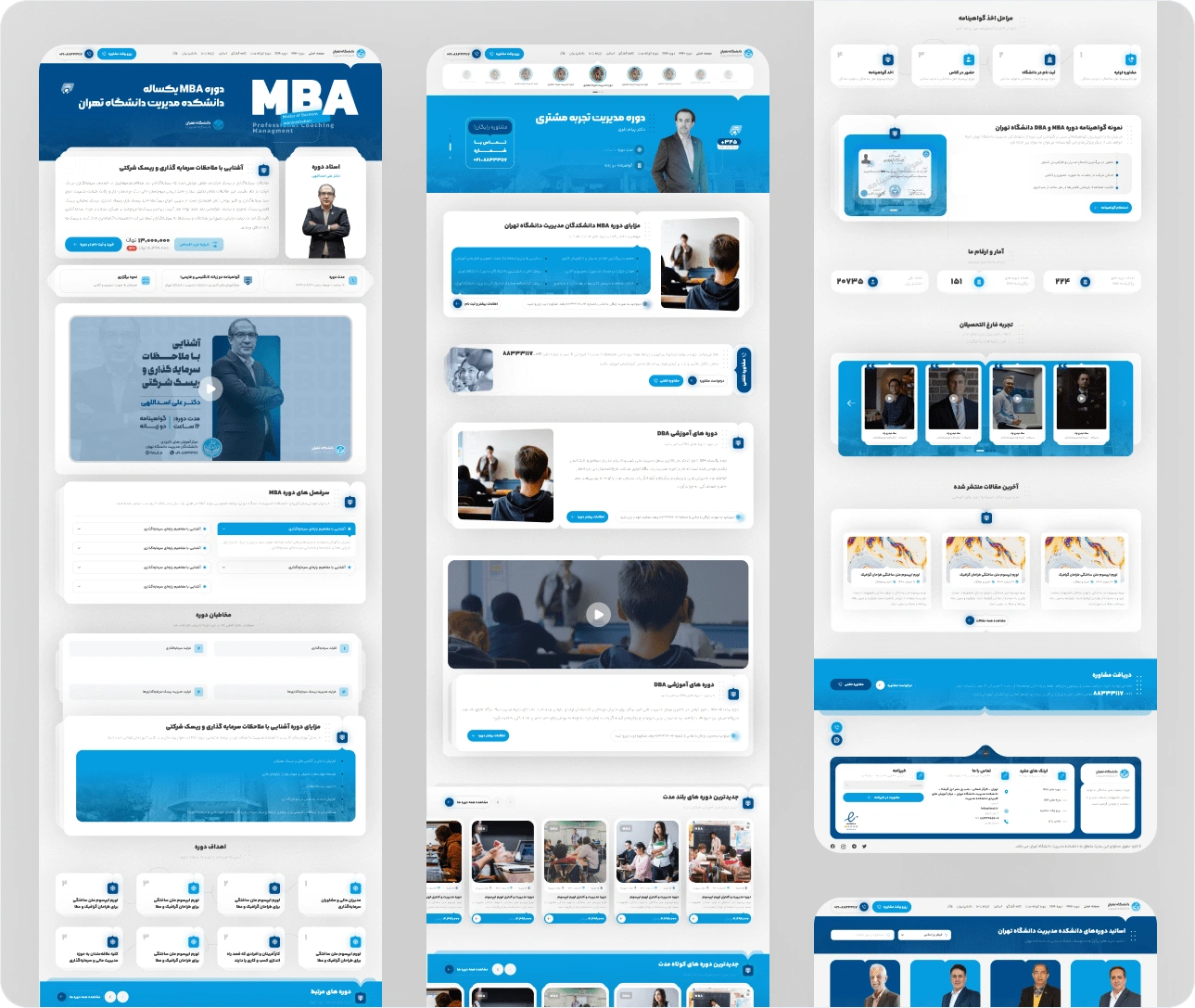



University of Tehran College of Management comprehensive virtual learning system (LMS)
Designed and built by Karzaan Software Group
1. Introduction: a project worthy of Iran’s leading management school
As the only AACSB-accredited school in Iran and the largest provider of MBA and DBA programs, the University of Tehran College of Management needed a system that brings together the educational, administrative and financial complexity of a top-tier institution. By designing a custom multi-module LMS, Karzaan Software Group digitally transformed how the full cycle of graduate management education is run.
2. The modules and their capabilities in detail
2-1. Registration and financial management
- A smart registration system:
- Supports a variety of programs: MBA (all tracks), DBA and short specialist courses.
- A multi-method payment platform:
- Full payment (through secure bank gateways with TLS 1.3 encryption).
- Installment payment (configurable rules: down payment + scheduled installments with automatic reminders).
- Automatic generation of invoices and accounting reports to the university’s standards.
2-2. Learning infrastructure
- Online classes:
- Deep integration with Adobe Connect:
- Automatic creation of a classroom with a dedicated link for each session.
- Automatic transfer of the learner list from the system to Adobe Connect.
- Smart attendance:
- Attendance recorded from class entry + activity in the environment (detecting a microphone/webcam inactive for more than 10 minutes).
- Notifications to absent learners and the relevant instructor.
- Deep integration with Adobe Connect:
- Testing engine:
- Exam types:
Exam type |
Capabilities |
|---|---|
Online |
Precise timing, randomized questions/options, full-screen mode with browser lock |
Offline |
Upload of scanned answer sheets, automatic comparison with the answer key |
Open-book |
Live video proctoring with AI face recognition |
- A dynamic question bank:
- Multiple-choice, descriptive and file-based (audio/image) questions.
- Tagging questions by difficulty and topic.
2-3. Specialized services
- Specialization system:
- A smart recommendation algorithm:
- Analyzes academic background + grades in core courses + a motivation survey.
- Produces a comparative report on suitable tracks (for example marketing, finance, human resources).
- A smart recommendation algorithm:
- Certificate issuance:
- Automatic certificates in the university’s standard format (digital seal, QR code for verification).
- Connection to national certificate verification systems.
- Parking pass sales:
- Configurable periods (per semester/day/hour).
- A smart map of free spaces on campus.
2-4. Resource management and support
- A dedicated instructor panel:
- Uploading course materials (video, PDF, links).
- Grade entry with two-step approval (instructor + head of department).
- Tracking learner progress through an analytics dashboard.
- Ticketing system:
- Smart categorization of requests (academic, financial, technical).
- Automatic assignment of tickets to the right staff member by expertise.
- Response time tracking (SLA).
- An integrated CMS:
- Managing the website’s dynamic content (news, events, faculty profiles).
- On-page SEO optimization with a keyword analysis tool.
2-5. Comprehensive reporting
- Management dashboards:
- Enrollment by program/track.
- Instructor performance analysis (average grades, satisfaction).
- Financial statistics (full/installment revenue, parking passes).
- Security reports:
- A full log of user activity (logins, data changes).
- Monitoring suspicious financial transactions.
3. Advanced technical architecture
3-1. Development layers
Layer |
Technology |
Technical details |
|---|---|---|
Admin panel |
PHP 8.1 + Yii2 |
MVC structure, RBAC for access levels (general, financial and academic managers), financial transactions processed with the yii2-payment module |
Frontend |
Next.js 14 + React |
Server-side rendering (SSR) for SEO, an interactive user panel with drag & drop, image optimization with Next/Image |
Web services (APIs) |
Node.js + Express |
Communication between modules over a RESTful API + WebSocket for real-time notifications (for example, class start alerts) |
Database |
MongoDB Atlas |
Storage of semi-structured data (registrations, analytics reports, CMS content) with sharding for scalability |
3-2. Technical challenges and solutions
- Adobe Connect integration:
- A custom module built on the Adobe Connect API (V8) for managing rooms, users and attendance reports.
- Multi-layer security:
- Two-factor authentication (2FA) for administrators.
- AES-256 encryption of sensitive data in MongoDB.
- JWT token validation in the API layer.
- Handling heavy traffic:
- Redis caching for repeated data (course lists, instructor information).
- Load balancing across the Node.js servers.
4. The project’s key achievements
- 150+ concurrent courses supported with 5,000+ active learners.
- 70% fewer financial errors by automating payments and installments.
- 40% better user experience according to learner surveys (99.9% availability).
- Security approval from the University of Tehran’s sensitive data center (ISO 27001).
5. Conclusion: a symbol of Karzaan’s technical maturity
By smartly combining 4 platforms (PHP/Yii2, Next.js, Node.js, MongoDB) and implementing 11 key modules, this project not only met the complex needs of Iran’s largest management school but also set a new standard for university LMSs. The system’s multi-layer architecture allows future modules such as AI analysis of classroom interactions and dropout prediction. With this project, Karzaan proved its ability to run enterprise software ecosystems.
To learn about learning systems and how AI is used in them, read these articles on the Karzaan blog:
- Personalized learning for organizations (LXP)
- Custom learning management system (LMS) design: a complete guide for organizations (in Persian)
- LMS vs. LXP: which is right for your organization?
- Checklist for choosing an LMS design company: questions to ask before signing (in Persian)
- Enterprise LMS cost: a full breakdown by features and project scope (in Persian)
- LMS or LXP? Why leading organizations choose both (in Persian)