


.png)
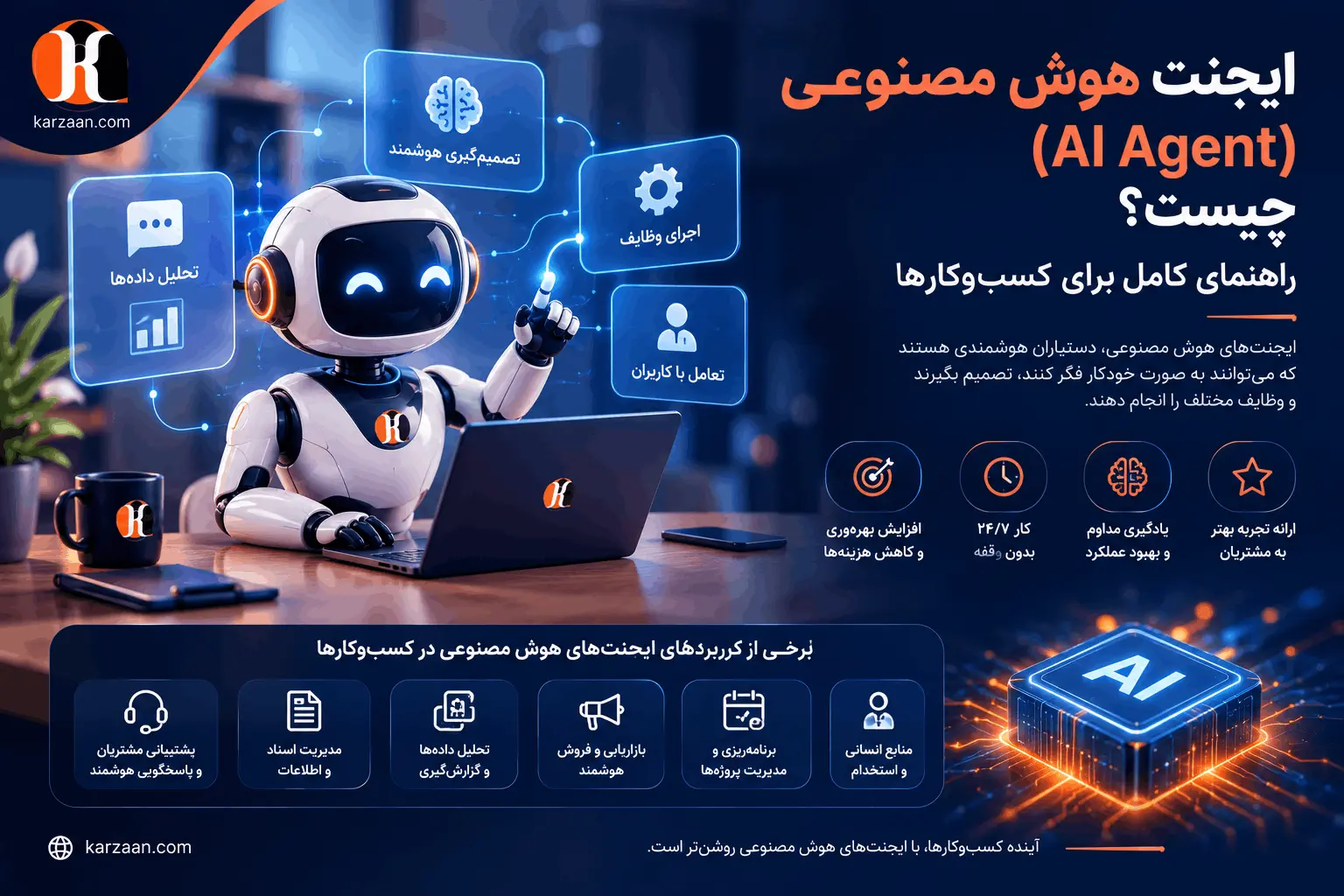
What is an AI Agent?
An AI Agent is a software system capable of independently perceiving its environment, making decisions, and taking actions to achieve a specific goal. Unlike traditional language models that simply respond to input, an AI Agent can plan multiple steps sequentially, call different tools, and continue until it reaches a final result.
Simply put, an AI Agent has three core properties:
- Perception: Receives information from the environment — text, data, images, or tool results
- Reasoning: Analyzes and decides what the next step should be
- Action: Performs a specific action — web search, code execution, sending email, calling an API
This perceive-reason-act cycle repeats until the task is complete. This is what distinguishes AI Agents from a simple chatbot.
What is the Difference Between an AI Agent, Chatbot, and Language Model?
Language Model (LLM)
A language model like GPT or Gemini takes input and generates text output. It has no memory of previous conversations, calls no tools, and cannot perform independent work. It is purely a text prediction engine.
Chatbot
A chatbot sits on top of a language model and creates a conversational interface. It may maintain conversation memory, but typically only responds — it does not take independent action. If you ask "what was the last invoice for customer X?" a simple chatbot cannot connect to your database and answer.
AI Agent
An AI Agent doesn't just respond — it acts. It can connect to your database, retrieve invoice information, prepare a summary, and if the invoice is overdue, automatically send a reminder email — all in one automated flow without human intervention.
How Does an AI Agent Work? Internal Architecture
1. Reasoning Core
A powerful language model (such as GPT-4o, Claude, or Gemini) sits at the center of the agent. This core decides what the next step should be, which tool to call, and when the task is complete.
2. Tools
Tools are capabilities the agent can use. The most common include:
- Web search and information extraction
- Running Python code for calculations
- Reading and writing files
- Calling external APIs (CRM, ERP, databases)
- Sending email, messages, or notifications
- Interacting with browsers and websites
3. Memory
Advanced agents have several types of memory:
- Short-term memory: Current conversation content
- Long-term memory: Information stored in a database or vector store for future retrieval
- Semantic memory: General knowledge acquired from training
4. Planning
Before acting, the agent must plan the path to its goal. Common methods include:
- ReAct (Reasoning + Acting): The agent thinks, then acts, then reviews the result
- Chain-of-Thought: Step-by-step reasoning before decision-making
- Tree of Thoughts: Exploring multiple parallel paths and choosing the best
Types of AI Agents
Simple Reflex Agents
These agents act based on predefined rules. If condition X holds, perform action Y. They have no memory and cannot handle complex situations.
Model-Based Agents
These agents maintain a model of the world and can track the state of the environment even when it is not directly observable. They know "where they currently are" and keep a history of interactions.
Goal-Based Agents
These agents have a specific goal and make all decisions based on which action brings them closer to it. Example: an agent whose goal is to book the cheapest flight meeting specific conditions.
Utility-Based Agents
The most advanced type of single-goal agents. They not only seek to reach the goal but choose the best path — not just a cheap flight, but the cheapest flight with fewest stops and best departure time.
Multi-Agent Systems
Multiple specialized agents collaborate together. An Orchestrator agent divides tasks, and specialist agents (research, writing, review) each handle a part. This approach suits highly complex tasks.
Practical Applications of AI Agents in Business
Intelligent Customer Service
AI agents can play the role of a professional customer service representative — answering questions, tracking orders, logging complaints, and in more complex cases automatically escalating to a human team. Unlike traditional chatbots limited to predefined questions, an AI Agent can integrate with your CRM and retrieve real customer information in real time.
Financial Process Automation
A financial agent can process invoices, identify suspicious transactions, prepare financial reports, and present options for manager approval. Companies using these agents report invoice processing time dropping from hours to minutes.
Market Research and Analysis
Instead of your team spending hours gathering data from various sources, an AI Agent can do it in minutes: searching the web, analyzing competitor reports, identifying market trends, and preparing a comprehensive report.
Human Resources Management
In recruitment, an AI agent can review resumes, ask initial screening questions, schedule interviews, and send response emails to applicants — freeing up weeks of HR team time.
Technical and IT Support
IT agents can categorize support tickets, automatically resolve common issues, reference technical documentation, and only escalate complex tickets to the human team — significantly reducing the support team's workload.
Benefits of AI Agents for Businesses
1. Significant Reduction in Operational Costs
Many processes that required large teams can now be managed by a few AI agents. This doesn't mean eliminating human staff — your team can focus on strategic and creative work instead of repetitive tasks.
2. Unlimited Scalability
A human can interact with a limited number of customers per day. An AI agent can simultaneously interact with thousands of customers without quality degradation. As your business grows, agents scale at the same pace.
3. 24/7 Availability
AI agents have no holidays, no fatigue, and work at the same quality around the clock. For businesses with customers across different time zones, this is a critical advantage.
4. Integration with Existing Systems
One of the greatest advantages of AI agents is that they can integrate with your existing systems. No need to rebuild everything from scratch. A well-designed agent can connect to your CRM, ERP, database, and cloud services.
5. Reduction of Human Error
In repetitive processes such as data entry, form processing, or calculations, AI agents significantly reduce human errors — particularly important in industries like finance, healthcare, and legal.
Challenges and Limitations of AI Agents
Compounding Errors
When an agent makes a mistake in the first step, it may compound across subsequent steps. A well-designed system must have review and correction mechanisms.
Need for Human Oversight
AI agents still require oversight, especially for important decisions. The best approach is for the agent to handle repetitive work while humans approve at critical decision points.
Security and Privacy
When an agent has access to sensitive business data, security becomes paramount. Agents should only have access to the data they need, and their behavior must be traceable.
Integration Complexity
Although agents can integrate with existing systems, this process requires specialized programming. Designing an agent that works correctly with your systems is a real engineering project.
How to Build an AI Agent for Your Business
Step 1: Identify Suitable Processes
Not all processes are suitable for AI automation. Best candidates are: repetitive, rule-based, high-volume, and measurable. Start small — choose one process where automation would have the greatest positive impact.
Step 2: Choose the Right Tool or Platform
Three main paths exist:
- No-Code/Low-Code platforms: Such as Make.com or Zapier, suitable for simple processes
- Development frameworks: Such as LangChain, CrewAI, or AutoGen for building complex agents
- Custom development: Building a fully custom agent with language model APIs
Step 3: Design Tools and Integrations
Determine what systems the agent needs access to. Prepare the necessary APIs and carefully define access permissions. Apply the Principle of Least Privilege.
Step 4: Test, Optimize, and Monitor
Before going live, test with various scenarios in a staging environment. After launch, continuously monitor the agent's performance and optimize as needed.
Custom AI Agents with Karzaan
At Karzaan, we design fully custom AI agents for businesses. Our expertise lies in building agents that integrate with your existing systems — not an off-the-shelf product you must adapt to, but an agent built precisely around your business processes and needs.
Our AI Agent services include:
- Design and development of custom AI agents
- Integration with your CRM, ERP, and databases
- Multi-agent systems for complex processes
- Smart assistants with Persian, Kurdish, and Arabic NLP
- Ongoing support and optimization