

AI Agents in HR and Recruitment | Use Cases and Design
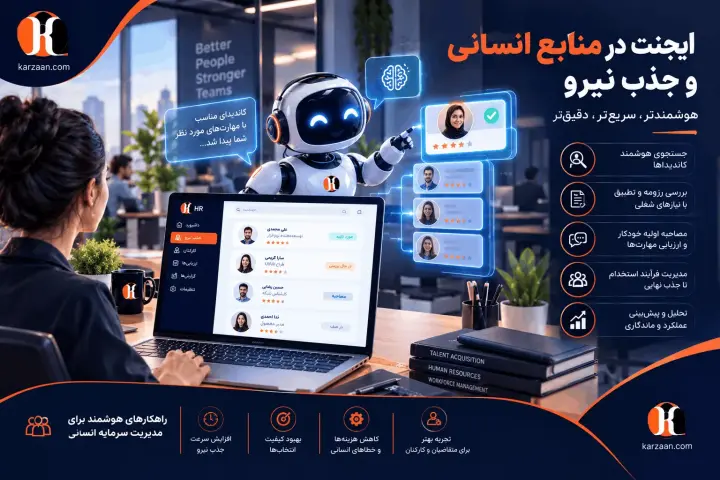
Every day the HR department carries hundreds of CVs, employees’ repeated questions, interview scheduling and chasing review forms, and this work takes away the specialists’ chance to focus on people. AI agents can lift a large part of this load, not by replacing people but by handling repetitive work, connecting scattered systems and preparing better information for decisions. In this article we review agent use cases across the whole employee lifecycle, from recruitment and hiring to onboarding, help desk, training, review and retention, give examples from different industries, explain the technical architecture and ethical risks, and propose a practical roadmap for getting started. If you are an HR manager, training manager or CEO, this guide helps you know which process to start with and what to take seriously from the outset.
In this article
- 01 Why is human resources fertile ground for AI agents?
- 02 Mapping agents onto the employee lifecycle
- 03 The recruitment agent: from job ad to final shortlist
- 04 The onboarding agent: a new employee’s first days
- 05 The employee help desk agent (HR service desk)
- 06 The learning and skills development agent
- 07 The performance review and feedback agent
- 08 The retention and workforce analytics agent
- 09 HR agent use cases in different types of organizations
- 10 The technical architecture of an HR agent
- 11 Privacy, fairness and ethical risks
- 12 A step-by-step implementation roadmap
- 13 How do you measure an HR agent’s success?
- 14 Conclusion and next steps with Karzaan
AI agents in human resources: from simple assistant to real HR teammate
In most organizations the human resources department is always under pressure: hundreds of CVs for a single job ad, dozens of repeated questions about leave and payslips, scheduling interviews, onboarding new hires, performance reviews and countless small tasks that eat up the specialists’ time. The result is that HR’s core work, understanding people, building the organizational culture and keeping talent, is usually pushed to the margins. AI agents are built for exactly this point: systems that don’t just answer, but pursue a goal, carry out several steps in a row, connect to the organization’s systems and hand the decision back to a human wherever needed.
If you are not yet familiar with the concept of an agent, we suggest first reading What is an AI agent? (in Persian). This article is the fourth part of our “Agents in industry” series, and unlike the previous parts, which focused on a specific industry, it turns to a department that exists in every organization. Below we review agent use cases across the whole employee lifecycle from hiring to exit, explain the technical architecture, go over the ethical and legal risks and offer a practical roadmap for getting started. The goal is that after reading it, an HR manager or CEO knows where to begin and what to expect from Karzaan’s AI services.
Why is human resources fertile ground for AI agents?
Not every process is a good fit for automation with an agent. Agents create the most value where three things come together: a high volume of repetitive work, the existence of data and written knowledge, and the need for language-based interaction with people. HR has all three. A large part of this department’s work deals with text: CVs, job descriptions, policies, review forms, emails and messages. That text-heavy nature is what allows large language models to play a serious role in it.
On the other hand, HR is the department that deals with every single employee. Each employee contacts it dozens of times a year, sometimes for a simple question about their remaining leave and sometimes for a sensitive matter such as a transfer or promotion. If an agent can answer the simple questions instantly and accurately, human specialists free up time for the sensitive, human conversations.
The repetitive, high-volume tasks that consume HR’s time
If you logged one working week of an HR specialist, you would probably end up with a list like this:
- Reading and sorting CVs, many of which have nothing to do with the job
- Coordinating interview times between the candidate, the line manager and the technical expert
- Answering repeated questions about leave, insurance, working hours and benefits
- Preparing documents and onboarding forms for new hires
- Chasing managers to complete performance review forms
- Preparing periodic reports for senior management
None of these tasks is unimportant, but none of them requires deep human judgment either. These are exactly the tasks a well-designed agent can largely take over, provided it has access to the right data and tools.
How an agent differs from a chatbot and old-style automation
Many organizations have already tried simple chatbots or automated workflows and were not happy with the result. The old chatbot only knew a few predefined scenarios and got stuck at the slightest change in the question. Process automation only ran fixed paths, and when an exception came up, the work stopped.
An AI agent differs in three fundamental ways. First, it understands natural language, so employees don’t have to phrase their question with particular keywords. Second, it can plan several steps to reach a goal; for example, to answer “How many days of leave do I have left, and what happens if I take three days next week?” it reads the attendance system, checks the policy and drafts the request. Third, it uses tools, meaning it gets work done instead of just talking. To learn more about which parts of a business should use AI, see Where should we use artificial intelligence? (in Persian).
Mapping agents onto the employee lifecycle
The best way to think about agents in HR is to look at the employee lifecycle. From the moment employees see a job ad to the day they leave the organization, they pass through several distinct stages, and at each stage one or more agents can help them and the HR team. The table below gives an overview of this map:
| Stage | Suggested agent | Main output |
|---|---|---|
| Recruitment and hiring | Recruitment agent | More precise job ads, a shortlist of candidates, an interview schedule |
| Joining the organization | Onboarding agent | A personal plan for the first days and answers to newcomers’ questions |
| Day-to-day work | Employee help desk agent | Instant answers to administrative questions and logging of requests |
| Growth and learning | Learning agent | Skill-gap analysis and a personal learning path |
| Review | Performance agent | Gathering evidence and helping with fair feedback |
| Retention and exit | Workforce analytics agent | Spotting attrition risk and analyzing reasons for leaving |
The important point is that these agents don’t all need to be built at once. Successful organizations usually start with one stage, measure the result and then move on to the next. Below we look at each of them in more detail.
The recruitment agent: from job ad to final shortlist
Hiring is probably HR’s most expensive and riskiest task. A wrong hire wastes months of the organization’s time, and a missed opportunity can send the best candidate to a competitor. The recruitment agent isn’t meant to decide who gets hired; its role is to make the process faster, more orderly and fairer, so the human decision-maker has better information at hand.
Writing the job description and job ad
Many hiring problems start with the ad itself. Vague, generic ads attract lots of irrelevant CVs. The recruitment agent can talk with the line manager to pin down the real need: exactly what problem does this role solve? What must be done in the first three months? Which skills are essential and which are only a plus?
Based on those answers, it then updates the organization’s standard job description and writes different versions of the ad for different channels: a formal version for the company website, a shorter one for social media and one for job boards. The agent can also check the ad’s wording for discriminatory or unnecessarily restrictive phrases. To learn about tools that help produce this kind of content, read The best AI tools for content creation (in Persian).
Screening CVs against transparent criteria
CV screening is where the agent saves the most time, but it is also where the greatest risk lies. The right approach is for the agent to compare CVs against explicit, pre-agreed criteria instead of giving a vague “score”. For example, if the criteria are “at least two years of back-end development experience”, “familiarity with relational databases” and “experience working in teams on enterprise projects”, the agent states for each CV which criteria it meets, where in the CV the evidence is, and which criteria are unclear.
The output of such an agent is a reviewable table, not a magic number. The HR specialist can see why a candidate made the shortlist and correct the agent’s decision if needed. This transparency both raises decision quality and makes it possible to answer to candidates and regulators.
Scheduling interviews and communicating with candidates
Coordinating interview times between several people is one of the most time-consuming administrative parts of hiring. The agent can access the interviewers’ calendars, send the candidate a few suggested times, receive the reply, send invitations to everyone and send a reminder the day before. If someone cancels, the agent finds a replacement slot on its own.
Another important part is the candidate experience. Many candidates are unhappy about being left in the dark for weeks, and that bad experience damages the organization’s employer brand. The agent can update candidates on the status of their application at every stage, answer common questions about the company and the process, and even send rejection messages respectfully and on time.
Helping the interviewer, not replacing them
Before the interview, the agent can prepare for the interviewer a summary of the candidate’s CV, its strengths and open questions, and a set of suggested questions tied to the needs of the job. After the interview, it can structure the interviewers’ notes and set them against the job criteria, so the decision meeting is held on the basis of evidence.
What the agent must not do is judge a candidate’s personality, tone or appearance from voice or video. This kind of analysis is scientifically questionable and carries a high risk of discrimination. The final hiring decision must always stay in human hands.
The onboarding agent: a new employee’s first days
The first days on the job determine how quickly new employees become productive and how likely they are to stay. In many organizations onboarding means an introductory meeting, a bundle of files and leaving the newcomer alone with a pile of unanswered questions. The onboarding agent makes this experience personal and continuous.
Before day one, the agent can get in touch with the new hire, request the required documents, complete the forms and notify IT and administration to prepare the user account, equipment and access rights. This coordination across several departments is exactly what usually gets forgotten, leaving new employees without a system or email on their first day.
A personal 30-, 60- and 90-day plan
Based on the role, the department and the employee’s level of experience, the agent proposes a personal onboarding plan: whom to meet in the first month, which trainings to complete and which documents to read; which small tasks to take responsibility for in the second month; and what concrete output is expected in the third month. The line manager reviews and finalizes this draft.
Throughout this period, the agent tracks progress, sends the necessary reminders to the employee and their manager, and reports if anything falls behind. The result is that no new employee gets forgotten in the rush of daily work.
Answering the questions newcomers are too shy to ask
A new employee has dozens of small questions: where is lunch served? Whom do I tell when I want to take leave? How do I open this system? What do the abbreviations used in meetings mean? Many of these questions are never asked, because the employee doesn’t want to bother colleagues or look uninformed.
An agent with access to the organization’s internal documentation, policies and knowledge base can answer these questions without judgment at any hour and show the source of each answer. This simple thing noticeably raises the new employee’s sense of security and belonging.
The employee help desk agent (HR service desk)
The fastest return on investment among HR agents probably comes from the employee help desk agent. It acts like an always-available service desk that receives, answers or logs employees’ administrative questions and requests. Its natural home is the organization’s internal portal; if your organization doesn’t yet have an integrated portal, What is an enterprise portal? (in Persian) is a good starting point.
What sets this agent apart from an FAQ page is that it builds the answer for that particular employee using their real data. When an employee asks “Did last month’s overtime show up on my payslip?”, instead of a general explanation the agent checks that month’s payslip and gives a precise answer.
Policies, regulations and circulars
Internal policies are usually long, scattered and sometimes contradictory. A new circular is issued, but the old version keeps circulating in various folders. The help desk agent uses a method called retrieval-augmented generation (RAG) to answer only from valid, up-to-date versions of documents, and states in each answer which clause of which document it used.
This has two benefits: employees can verify the answer, and HR can see which part of the policy raises the most questions. If one clause triggers questions over and over, it probably needs rewriting. In this way the agent also becomes a tool for improving the policies themselves.
Leave, pay, insurance and payslips
A large share of contacts with HR concern leave, pay, insurance and benefits. To answer these questions, the agent must be connected to the organization’s HR and payroll systems. If these systems are old and siloed, the first step is to build an integrated layer. In Custom HRM software (in Persian) we explained why many organizations need a tailored system for this.
With this connection, the agent not only answers but also logs the request: it drafts the leave request, sends it to the manager for approval, informs the employee of the result and, if the request is rejected, explains why. In sensitive matters such as a pay dispute or a complaint, the agent passes the case to a human specialist with a full summary, so the employee doesn’t have to tell the story from the start.
The learning and skills development agent
Training is one of the areas where agents can bring real transformation. Most organizations still run training as identical courses for everyone, even though each employee’s needs are different. In AI in corporate training (in Persian) we explained in detail how AI personalizes learning; here we focus on the agent’s role.
Individual and organizational skill-gap analysis
The learning agent can put each employee’s job description, performance review results, departmental goals and training history side by side and identify their skill gap. For example, it can tell that a sales specialist is strong in negotiation but weak in analyzing customer data, or that a production supervisor has deep technical knowledge but has practiced team leadership less.
When this analysis is aggregated across the whole organization, the training manager gets a clear picture of real needs and, instead of running repetitive courses, spends the training budget on the skills with the greatest impact on performance.
A personal learning path with an LXP
The result of the skill-gap analysis has to turn into a practical learning path. This is where the learning experience platform, or LXP, comes in. Karzaan’s smart LXP was built for exactly this: it recommends learning content based on each employee’s role, level and interests, answers learners’ questions with a smart assistant and tracks progress. For a full introduction to the concept, read What is an LXP? (in Persian).
If your organization is still torn between a learning management system and a learning experience platform, The difference between an LMS and an LXP (in Persian) will help you choose. In many organizations combining the two works best: an LMS for mandatory, formal training and an LXP for continuous, personal learning. The learning agent can be the bridge between them, taking mandatory course reminders from the LMS and personal growth recommendations from the LXP.
The performance review and feedback agent
In many organizations performance review has become an annual formality: managers fill in the forms in the last few days based on their memory of recent weeks, and employees don’t consider the result fair. The review agent can turn this process from an annual event into a continuous, evidence-based flow.
Gathering performance evidence throughout the period
With controlled access to project management systems, tickets, recorded goals and periodic feedback, the agent collects evidence of each employee’s performance throughout the period: which goals were achieved, which projects they contributed to and what feedback they received from colleagues and customers. The result is a documented file the manager has at hand during the review.
This approach reduces “recency bias”, where the manager only remembers the work of the last few weeks. Care is needed, however, so that the agent doesn’t become a tool for constant, intrusive monitoring. The data the agent collects must be defined in advance, limited to work goals and transparent to the employee as well.
Helping write fair, constructive feedback
Many managers are not skilled at writing feedback; they write either too vaguely or too harshly. Based on the evidence gathered, the agent can prepare a feedback draft that describes specific behaviors, recognizes strengths and offers practical suggestions for growth. It can also flag vague or biased phrases in the manager’s text.
This draft is only a starting point, and the manager must complete it with their personal knowledge. A performance review is a human conversation, and the agent only raises the quality of the preparation.
The retention and workforce analytics agent
Losing an experienced employee is very costly for an organization, not only because of the cost of hiring a replacement but because of the knowledge that leaves with them. The workforce analytics agent helps make this less of a surprise.
Spotting signs of attrition risk
The agent can detect general patterns in organizational data: departments where turnover has risen, roles that haven’t seen a promotion for a long time, teams where satisfaction survey results have dropped, or employees who have gone a long time without training or a new challenge. The output of this analysis should be presented at team and department level, helping managers act before the situation becomes critical.
Using these analyses to label individuals or act against them is completely wrong. The goal is to improve working conditions, not to identify and remove “unhappy” employees. This boundary should be written explicitly into the organization’s policies.
Exit interviews and learning from them
Many employees don’t state their real reason for leaving in a face-to-face exit interview. The agent can hold a structured, confidential conversation with the departing employee and analyze the answers anonymously alongside other interviews. When dozens of exit interviews are aggregated, the real patterns emerge; for example, that the main dissatisfaction is with career paths or with the management style of a particular department.
The agent can also manage knowledge transfer: collecting the departing employee’s task list, access rights, documentation and key relationships so their successor can carry on with minimal interruption.
HR agent use cases in different types of organizations
The HR needs of a steel plant are not the same as those of a bank or a university. Agent design has to start from the reality of each organization, not from a ready-made template. Below we review four common examples.
Industrial, manufacturing and mining companies
In industrial organizations, a large share of employees don’t sit behind a desk and have no constant access to email or a computer. In this environment the HR agent must be available through mobile, shop-floor kiosks or a messaging app, and work with simple language and even voice messages. Common questions in these organizations concern shifts, overtime, assignments and leave.
Another important area is safety training and technical qualifications. The agent can track the validity of each person’s safety certificates, send reminders before they expire and prevent anyone from being sent to a sensitive shift without the required training. Karzaan’s experience with the Zisa comprehensive HSE system shows how valuable it is to connect safety and HR data. To see specialized agent use cases in these industries, read AI agents in the steel and mining industries (in Persian) and AI agents in oil, gas and petrochemicals (in Persian).
Banks and financial services companies
In banks and fintech companies there are many branches and employees, and compliance requirements and mandatory regulatory training are heavy. The HR agent in these organizations can take over tracking mandatory training such as anti-money laundering and information security, coordinate staff moves between branches and answer the wide range of questions from branch employees.
Because these organizations’ data is highly sensitive, the agent usually has to be deployed on internal infrastructure with precise access control. We reviewed agent use cases in the customer-facing parts of a bank in AI agents in banking and fintech (in Persian).
Universities and educational institutions
Universities deal with two large groups: staff and faculty members on one side, and adjunct and project-based instructors on the other. Hiring, contracts, teaching evaluation and promotion processes in these institutions are complex and full of regulations. The agent can help faculty members understand promotion regulations, collect the required documentation and report on the status of their file.
As an official contractor of the University of Tehran, Karzaan has experience building the University of Tehran’s comprehensive applied and professional training system and knows how different academic processes are from those of commercial organizations. If you are looking for a learning system that fits your own structure, see Designing a custom LMS (in Persian).
Project-based and contracting companies
In contracting and project-based companies, staff constantly move between projects and some employees are on temporary contracts. HR’s main challenge in these companies is quickly finding the right person for a new project and managing a large number of contracts.
The agent can maintain a skills bank of current employees and, when a new project is defined, suggest available people with the right skills. It also tracks contract end dates and reminds the relevant manager of the renewal or termination decision before each contract ends.
The technical architecture of an HR agent
A successful HR agent is not just a language model. Behind it are several technical layers that must be carefully designed. If any of these layers is weak, the agent either gives wrong answers or gains access to data it shouldn’t.
The data layer and integration with HRM and ERP
To do real work, the agent needs real data: personnel records, attendance, payroll, organizational structure, training history and policy documents. In most organizations this data is scattered across several separate systems. If the organization uses an enterprise resource planning system, part of this data usually lives there; to learn about the benefits of ERP software (in Persian) and the challenges of ERP integration (in Persian), see these two articles.
The right approach is to build a secure API layer through which the agent accesses only permitted data, rather than a direct connection to the database. This layer is effectively part of your enterprise software (in Persian) and must be designed to the same standards.
Tools, access levels and human in the loop
Every agent has a set of tools: reading the leave balance, logging a request, sending an interview invitation, searching the policies and so on. Designing these tools is the most important technical decision. The key principle is that the agent always works with the identity and access level of the user it is talking to; that is, an ordinary employee must never be able to reach a colleague’s salary through the agent.
The second principle is defining “human in the loop” points. Low-risk tasks such as answering a question or logging a leave request can be automatic, but any action that affects someone’s employment status, pay or contract must be approved by a human before it is carried out. All of the agent’s actions must also be recorded in an auditable log.
Channels: portal, mobile app and messaging
The agent must be where employees actually are. For office staff, the enterprise portal and email are enough, but for field and shop-floor staff, a mobile app or an internal messaging app is the main channel. In Enterprise mobile app design (in Persian) we explained the key points of building such a channel.
The user experience of these channels matters a lot too. If an employee can’t reach the agent within a few seconds or doesn’t understand the answer, they go back to the phone and in-person visits. Read the principles of this design in Enterprise UI/UX design (in Persian).
Privacy, fairness and ethical risks
Human resources holds the organization’s most sensitive data, and its decisions directly affect people’s lives. That is why an HR agent needs a clear ethical and governance framework more than any other agent. An organization that doesn’t take this seriously may lose its employees’ trust and face legal risks.
Bias in screening and decision-making
AI models learn from past data, and if the organization’s past hiring was biased, the agent will repeat and even amplify that bias. Several measures are essential to reduce this risk:
- Removing information unrelated to the job, such as age, gender, marital status and photos, from the screening input
- Using explicit, documented criteria instead of an overall score
- Periodically reviewing the agent’s results to detect unfair patterns between different groups
- Allowing human review for any candidate who has been rejected
- Being transparent with candidates about the use of AI in the process
Security of personnel data
Salary information, medical records, reviews and employees’ identity documents must not be sent to external services without control. For many Iranian organizations, using models that can be deployed on internal infrastructure, or at least masking sensitive data before sending it to the model, is a requirement. Encryption, role-based access control, logging and periodic deletion of unnecessary data are also inseparable parts of the design.
In addition, agents face their own security risks such as prompt injection; for example, a CV whose text contains a hidden instruction meant to trick the screening agent. To learn about the general principles of web system security, see Ways to increase website security (in Persian).
A step-by-step implementation roadmap
Implementing an HR agent is a project that is likely to fail if it starts all at once and on a large scale. Our suggested path is a phased approach that produces tangible value at each stage and gradually builds employees’ trust.
Choosing the first use case
The first agent should have three characteristics: a high volume of requests, low risk and available data. In most organizations an agent that answers policy and administrative questions is the best starting point, because it is read-only, has no direct effect on sensitive decisions and its results are visible quickly.
Some groundwork is essential before starting: collecting and cleaning up valid documents, removing old versions, assigning an owner to each document for updates and specifying the topics the agent must refer to a human specialist.
Pilot, measurement and expansion
The agent is first activated for one department or a limited group of employees. At this stage every conversation is reviewed, wrong answers are corrected and incomplete documents are filled in. Once acceptable quality is reached, the agent is rolled out to the whole organization, and in the next phase the ability to take action, such as logging requests, is added.
Once the help desk agent is established, it is time for more complex agents such as onboarding, learning and recruitment. Each new agent uses the infrastructure built in the first phase, namely the data layer, access control and communication channels, and is therefore built faster and at lower cost. Depending on the scope, the level of investment can range from a basic project for a single help desk agent to an enterprise project for a full set of agents.
How do you measure an HR agent’s success?
Without specific indicators, there is no way to know whether the agent has really created value or is just another attractive tool. Indicators should be defined in advance, and the current situation measured before launch, so comparison is possible.
| Area | Suggested indicator | What it shows |
|---|---|---|
| Help desk | Share of questions resolved without referral to a specialist | How much HR time has been freed up |
| Quality | Percentage of answers approved in sample reviews | The agent’s accuracy and reliability |
| Hiring | Time from posting the ad to the job offer | Speed of the recruitment process |
| Candidate experience | Candidates’ satisfaction with communication and the process | Effect on the employer brand |
| Onboarding | Time for new hires to reach productivity | Quality of joining the organization |
| Learning | Completion rate of suggested learning paths | Impact of personalized training |
| Fairness | Comparison of screening results between different groups | Absence of systematic bias |
Besides these indicators, qualitative feedback from employees matters too. Short surveys after each conversation and periodic meetings with employee representatives show how useful the agent has really been to them.
Conclusion and next steps with Karzaan
AI agents are not meant to take the humans out of human resources; on the contrary, the goal is to free HR specialists from repetitive work so they can spend their time on what only people can do: listening, empathy, resolving conflict and building the organizational culture. The recruitment agent makes hiring faster and fairer, the onboarding agent turns the first days into a pleasant experience, the help desk agent becomes an always-available service desk and the learning agent makes learning personal.
Success on this path depends on three things: orderly, integrated data; careful design of access rights and human approval points; and a small, smart start. With experience in building enterprise software, large learning systems and AI agents, Karzaan can accompany you from needs analysis to implementation and support. To learn more about Karzaan’s services and see our portfolio, or to get a free consultation on an HR agent for your organization, get in touch with the Karzaan team through our contact page.
Frequently asked questions
01 Will an AI agent replace HR specialists?
02 What is the best starting point for an HR agent?
03 Is using AI in CV screening fair?
04 Which systems should an HR agent connect to?
05 How is personnel data protected in an HR agent?
06 How does the learning agent relate to an LXP?
07 How much time and cost does implementing an HR agent take?
Reading path
 Article
What is an AI Agent? A Complete Guide for Businesses
Imagine having a smart assistant that not only answers your questions but autonomously makes decisions, uses tools, and completes complex tasks from start to finish — without constant guidance. This is exactly what AI Ag…
Read it
User Reviews
What users say about us
Post a New Review
No reviews have been posted for this project yet
Post a New Review
Send us your review