
AI Agents in Universities | Use Cases and Design
Every semester universities face a wave of repeated questions about course selection, add and drop, tuition and grades, and academic staff drown in messages. Professors also spend much of their time answering repetitive questions, designing exercises and grading. AI agents can lighten this load by knowing the regulations and course materials, connecting to the student information system and the LMS, and leaving academic decisions to people. In this article we review agent use cases from admissions and enrollment to student services, learning assistants, teaching assistants, exams and research, explain the technical architecture and the academic integrity and privacy considerations, and propose a practical roadmap for getting started. If you manage a university, faculty or educational center, this guide is for you.

In this article
- 01 Why do universities need AI agents?
- 02 Mapping agents onto the student and university lifecycle
- 03 The admissions and enrollment agent
- 04 The academic affairs and student services agent
- 05 The learning assistant agent for students
- 06 The teaching assistant agent for professors
- 07 The exam and assessment agent
- 08 The research and research administration agent
- 09 Agent use cases in different types of higher education institutions
- 10 The technical architecture of a university agent
- 11 Risks and important considerations
- 12 Implementation roadmap
- 13 How do you measure a university agent’s success?
- 14 Conclusion and next steps with Karzaan
AI agents in universities: from admissions and enrollment to learning and research
Every semester universities face the same wave: thousands of students asking at once about course selection, add and drop, tuition, online classes and grades, while academic affairs staff drown in messages and visits. Professors also spend a large part of their time answering repeated course questions, designing exercises and grading, leaving less time for research and in-depth guidance of students. AI agents can lighten this load: systems that know the regulations and course materials, connect to the student information system and the learning management system, actually move the work forward and hand anything involving an academic or disciplinary decision to a human.
This article is the eighth part of our “Agents in industry” series. If you are not familiar with the concept of an agent, first read What is an AI agent? (in Persian). In the previous part we looked at AI agents in the insurance industry (in Persian), and this time we turn to universities and higher education; an area where Karzaan, as an official contractor of the University of Tehran, has direct experience. Below we review agent use cases across the whole student lifecycle, from admission to graduation, as well as in the work of professors and researchers, explain the technical architecture and risks, and propose a practical roadmap. If you manage a university, faculty or educational center, this guide helps you know what to expect from Karzaan’s AI services.
Why do universities need AI agents?
A university is an organization that deals with thousands of “customers”, yet its service structure is usually not designed for that volume. For a simple task a student may have to visit several offices, search several systems or wait days for a reply to an email. This experience is exhausting both for students and for the staff who answer the same questions every day.
On the other hand, universities deal with text and written knowledge more than almost any other organization: academic regulations, course syllabi, lecture notes, papers and circulars. That is why language models and agents can be most useful in universities, provided they are designed properly and connected to authoritative sources.
High request volumes at peak times
The academic calendar has several clear peaks: new student enrollment, course selection, add and drop, exam weeks and grade release. On these days the volume of messages and visits multiplies, and these are exactly the days when students most need a quick answer, because deadlines are short and any delay can mean missing a course or a semester.
Many of the questions on these days are repetitive: “What is the prerequisite for this course?”, “Why can’t I take this course?”, “When does the single-course drop deadline end?”. The answers to all of them exist in the regulations and the student information system. An agent with access to these sources can give precise answers at any hour to thousands of students at once.
Scattered academic, financial and administrative systems
In many universities the academic system, the finance and tuition system, the learning management system, the library and housing services are separate. Students have to know which system to use for each task, and staff have to open several systems to see the full picture of one student.
An agent can act as a “single front door”: the student asks once and the agent gathers the information from the different systems. To see where AI creates the most value in an organization, read Where should we use artificial intelligence? (in Persian).
Mapping agents onto the student and university lifecycle
University agents can be mapped onto the student lifecycle and the university’s main roles. Each of these agents solves a specific problem:
| Area | Suggested agent | Main output |
|---|---|---|
| Admissions and enrollment | Admissions agent | Answering applicants, checking documents and guiding course selection |
| Academic and student affairs | Student services agent | Answers from the regulations and logging requests |
| Learning | Learning assistant agent | Answering course questions, practice and review |
| Teaching | Teaching assistant agent | Content design, exercises and help with feedback |
| Assessment | Exam agent | Candidate support and results analysis |
| Research | Research agent | Searching and summarizing sources and research administration |
A university doesn’t need to build all these agents at once. The logical path is to start with the area that has the most requests and the least decision risk, and then move forward step by step.
The admissions and enrollment agent
Every student’s first experience of a university is admission and enrollment. If this experience is confusing and full of back-and-forth, the student’s first impression of the university turns negative too. For open and skills courses, where the university has to compete for applicants, the quality of this stage directly affects enrollment numbers.
Answering applicants about programs and courses
Applicants want to know whom a course is for, what prerequisites it has, whether classes are in person or online, how recognized its certificate is and what its schedule looks like. Through conversation the admissions agent can understand the applicant’s need and suggest the right course or program.
These conversations are valuable for the university too: they show which skills and courses applicants are looking for that aren’t offered today. Such data is very useful for designing new courses.
Checking documents and completing the file
The agent lists the documents required for the type of admission, checks the uploaded documents and, if a document is missing, unreadable or inconsistent with the form, tells the applicant immediately. The file that reaches the admissions officer is complete and orderly.
The final admission decision, especially in special and exceptional cases, rests with the human officer. The agent only does the repetitive work and prepares the file.
Course selection guidance
Course selection is one of the most stressful tasks of every semester. By looking at the student’s transcript, completed courses, prerequisites and the semester’s timetable, the agent can tell them which courses they can take, which clash in time and which combination best fits their path to graduation.
This guidance doesn’t replace the academic advisor; it takes over the repetitive part of their work, so the advising session can be spent discussing the student’s academic and career path instead of checking prerequisites.
The academic affairs and student services agent
A large share of visits to the academic office and student affairs are questions whose answers are written in the regulations, but which students can’t find or don’t understand. The student services agent acts like an always-available officer who knows the regulations and also has access to the student information system. Its natural home is the university’s enterprise portal (in Persian) or student portal.
What sets this agent apart from an FAQ page is that it builds the answer for that particular student using their own data. When a student asks “Can I take a leave of absence this semester?”, the agent checks their previous leaves, probation status and years of study and gives a precise answer.
Regulations, add and drop and leave of absence
Using retrieval-augmented generation, the agent answers only from the valid, up-to-date version of the regulations and states the relevant clause in each answer. This has two benefits: students can verify the answer, and the academic office can see which clause of the regulations raises the most questions.
The agent can also log requests: it drafts a single-course drop, a leave of absence or a grade review request, sends it to the approving authority and informs the student of the result. Decisions on these requests rest with the officer or the academic council.
Student finances and tuition
Financial questions make up an important share of contacts, especially in fee-paying and open courses: “How much do I owe?”, “When is my next installment?”, “Why hasn’t my payment been recorded?”. With access to the finance system, the agent explains the student’s account status and, if a payment hasn’t been recorded, refers it for review.
In special cases such as requests for installment plans or waivers, the agent only logs the request with complete information and the decision rests with the finance office. The agent must not commit to any amount or discount.
The learning assistant agent for students
Perhaps the most important and sensitive use of agents in a university is the learning assistant. Throughout the semester students repeatedly face a concept they didn’t understand in class, an exercise they don’t know how to start or a source they can’t find. Professors and teaching assistants can’t always be available, but a well-designed agent can.
The main difference between this agent and general chatbots is that it is connected to the sources of that specific course: the professor’s notes, slides, the reference textbook and the semester’s exercises. Its answers match the language and approach of that course and lead students back to the course materials, not to a generic answer from the internet.
Answering course questions from the professor’s materials
A student can ask “What is the difference between these two concepts?” or “Explain this example from class more simply.” The agent answers from the course materials and states which session or section of the notes the answer comes from. If the question is outside the scope of the course, it says so honestly.
This assistant is especially valuable for students who are shy about asking questions in class or who study outside working hours. The professor, in turn, learns from the report of frequent questions which part of the course needs more explanation.
Review, practice and exam preparation
Based on the topics of each session, the agent can create review questions, check the student’s answers and show weak points. Before an exam it can suggest a personal review plan based on the topics where the student has been weaker.
This kind of personal learning is the same approach pursued by learning experience platforms. In AI in corporate training (in Persian) we explained how AI personalizes learning, and the same principles apply in universities.
The line between learning support and cheating
Professors’ biggest concern about AI tools is cheating. The learning assistant must be designed to “teach”, not to “give answers”. That means for graded exercises it should guide step by step instead of solving them completely, ask questions and get the student thinking.
The professor must be able to set, for each course and each exercise, how much the agent helps: full explanations for open practice, only guidance for graded assignments, and switched off during exams. These settings are an inseparable part of designing an educational agent.
The teaching assistant agent for professors
Besides teaching, university professors also do research, supervise theses and handle administrative work. Part of teaching, such as preparing exercises, answering repetitive emails and grading, takes a lot of time. A teaching assistant agent can lighten some of this load so professors have more time for teaching quality and research.
One of professors’ simple but time-consuming tasks is answering students’ repetitive emails and messages: when is the assignment due? When is the make-up class? When will the midterm grade be released? The teaching assistant agent can answer these questions from the announcements and the course schedule and pass on only the messages that really need the professor, with a clear summary.
Designing courses, content and exercises
Based on the approved syllabus, the agent can prepare a draft course plan for the semester, write learning objectives and suggested sources for each session and propose a set of exercises at different levels of difficulty. It can also summarize and index recorded sessions so students reach the part they need faster.
All of these outputs are drafts that the professor reviews and finalizes. Scientific quality and the choice of sources always rest with the professor.
Help with grading and feedback
In large courses, grading exercises and giving personal feedback to every student is almost impossible. The agent can compare answers against the assessment criteria the professor has defined, group common mistakes and prepare draft feedback for each student.
The final grade must be recorded with the professor’s approval. The agent only shortens grading time and helps feedback reach students in a more personal and timely way.
The exam and assessment agent
Running large exams, whether end-of-semester exams or proficiency and entrance tests, is a complex process with many candidates and many questions. Karzaan has worked closely with this complexity in designing exam systems for the University of Tehran. An exam agent can help both candidates and organizers.
In exams with candidates from several countries or cities, such as language and proficiency tests, multilingual support also matters. The agent can reply in the candidate’s language and personalize the information based on their test location and exam type; something that is very hard to do with a small human support team.
Supporting candidates before and after the exam
Candidates have many questions: when and where is the exam? Which documents should I bring? What are the technical requirements of the online exam? When will results be announced and how do I file an appeal? The agent can answer all these questions and greatly reduce the support load in the days before the exam, when question volumes are high.
After results are announced, the agent can log appeal requests with complete information and report on their status. Decisions on appeals rest with the relevant committee.
Analyzing results and spotting suspicious cases
The agent can analyze exam results: which questions were too easy or too hard, which question was probably ambiguous and which topics were weaker across the whole class. This analysis helps the professor both design better exams next time and spend more teaching time on weak areas.
In online exams, the agent can report unusual patterns, such as very similar answers, for review. These reports are only signals, and no student should be accused or penalized solely on the basis of an agent’s report. Review and decisions rest with the disciplinary committee.
The research and research administration agent
Research is one of the university’s core missions, and agents can help both with research work itself and with its administration. In this area, however, academic integrity and the researcher’s responsibility are especially important.
The key principle of a research agent is that it is a supporting tool, not a replacement for the researcher’s thinking. Choosing the problem, designing the method, analyzing results and writing up findings are the researcher’s responsibility; the agent only speeds up searching, organizing and administration. The university should also have a clear policy on permitted use and how it is declared in theses and papers.
Searching, summarizing and organizing sources
The agent can search databases and the university’s paper repository, find papers related to a topic, prepare a summary of each and group them by approach and findings. This speeds up the literature review stage for graduate students.
The important point is that the agent must always show the real source of every claim, and the researcher must read the original papers themselves. An agent that produces fabricated references is dangerous in an academic environment, and its design must control this risk from the ground up.
Administration of research projects and theses
Research administration processes, such as submitting proposals, tracking approval, scheduling defenses, filing progress reports and closing out projects, are usually complex and time-consuming. The agent can remind researchers of the steps, draft forms from existing information, report the status of each step and coordinate defense dates among examiners.
This agent also reduces the load on research office staff, who today spend much of their time answering repetitive questions about steps and forms.
Agent use cases in different types of higher education institutions
The needs of a large public university are not the same as those of an open-education center or an online faculty. Agent design must start from the reality of each institution. We review four common examples.
What all these institutions have in common is that the agent must be configured with that institution’s regulations, structure and language. An agent designed for one university is not suitable for another without reconfiguration, because each institution’s academic rules, systems and student needs are different.
Large public universities
In large universities the number of students, faculties and programs is high, and regulations sometimes differ between faculties. The student services agent must know which faculty and degree level the student is in and answer according to those rules. The high number of students means that even a small saving on each request has a large effect on staff workload.
In these universities, integration with existing systems is the main challenge; systems that have run for years and can’t be replaced overnight. The agent must connect to these same systems through a secure layer.
Open, applied and skills courses
Universities’ open and skills courses deal with a different audience: working people, managers and enthusiasts looking for a specific skill. These learners usually have many questions before enrolling and expect fast service afterwards. Admissions and learning assistant agents create the most value in these courses.
In building the University of Tehran’s comprehensive applied and professional training system, Karzaan worked closely with the needs of this kind of education, from enrollment and payment to classes and certificates. If you are looking to build such a system, read Designing a custom LMS (in Persian).
Management faculties and online education
Faculties offering management, executive or online programs have dispersed students with different schedules. These students rarely visit the faculty in person and mostly get in touch through online channels. In these institutions the agent almost becomes the main “service office”.
Karzaan became familiar with the needs of this kind of faculty in the University of Tehran College of Management project. For a comparison of available systems in this area, see The best learning management systems (in Persian).
Corporate training centers and continuous learning
Many large organizations have training centers that resemble universities: specialized courses, exams, certificates and career paths. University agents are useful in these centers too, but with more focus on continuous, personal learning.
In these centers, combining a learning management system with a learning experience platform gives the best result. Karzaan’s smart LXP is designed for exactly this kind of learning; to learn more, read What is an LXP? (in Persian) and The difference between an LMS and an LXP (in Persian).
The technical architecture of a university agent
A university agent is not just a language model. Behind it are layers that ensure accuracy, security and auditability. An important principle is separating “thinking” from “doing”: the model decides which tool is needed, but the action itself, such as logging a leave request, is carried out by the system’s controlled code under the academic rules.
Connecting to the student information system and the LMS
To do real work, the agent needs real data: transcripts, the semester timetable, prerequisites, financial status, course content and regulations. This data is usually kept in the student information system, the finance system and the learning management system. To learn about the role of an LMS, read What is an LMS? (in Persian).
The right approach is to build a secure API layer through which the agent accesses only permitted data. This layer is part of the university’s enterprise software (in Persian) and must be designed to the same standards.
Access levels and human in the loop
The agent must always work with the identity and access level of the user it is talking to. A student sees only their own information, a professor only the information of students in their own class and an officer only what falls within their remit.
A specific level of authority is also defined for each action. Answering questions and logging requests can be automatic, but recording or changing grades, approving leave, disciplinary decisions and any action that affects a student’s academic status must be approved by a human. All of the agent’s actions are also recorded in an auditable log.
Channels: portal, app and messaging
Today’s students mostly work on their phones. The agent must be available in the student portal, the university app and, where possible, popular messaging apps, and keep the conversation history across these channels. We explained the key points of building such a channel in Enterprise mobile app design (in Persian).
User experience matters a great deal too, especially on course selection days when students are under time pressure. Read the principles of this design in Enterprise UI/UX design (in Persian).
Risks and important considerations
A university is an environment where academic integrity, educational fairness and students’ privacy are fundamental. Any agent in a university must be designed with these considerations from the start.
Academic integrity and learning quality
If the learning assistant gives ready-made answers instead of teaching, it weakens learning. Several principles are essential to prevent this:
- The professor sets, for each course and exercise, how much the agent helps
- For graded assignments the agent gives step-by-step guidance instead of a full solution
- Answers are based on the course materials and the source of each answer is shown
- The agent never produces fabricated sources or references
- The university announces a clear policy on permitted use of AI in assignments and research
Privacy and security of student data
Transcripts, financial status, disciplinary records and students’ identity information are sensitive data. This information must not be sent to external services without control; for many universities, using models that can be deployed on internal infrastructure, or at least masking sensitive data before sending it to the model, is a requirement. Encryption, role-based access control and logging are also inseparable parts of the design.
Agents also face their own security risks; for example, an assignment whose text contains a hidden instruction meant to trick the grading agent. For the general principles, see Ways to increase website security (in Persian).
Implementation roadmap
Implementing an agent in a university is best aligned with the academic calendar. Before anything else, record the current situation: how many messages and visits reach the academic office each semester, which questions come up most, what the average response time is and where most student complaints come from. This baseline both makes it easier to choose the starting point and later shows what the agent has really changed.
The first use case
For most universities, an agent that answers regulatory and academic questions is the best start. It is low-risk, because it makes no decisions about grades or academic status, and its effect on reducing visits shows quickly. Its prerequisite is orderly, up-to-date regulations and circulars.
The learning assistant can also be launched at the same time in a few pilot courses with volunteer professors. This helps gather real experience from professors and students before rolling it out across the university.
A one-semester pilot and expansion
The best time for a pilot is a full semester, so the agent experiences every peak, from course selection to exams. During this semester every conversation is reviewed and errors are corrected. Once acceptable quality is reached, the agent is activated across the university and the ability to log requests is added.
More sensitive agents, such as grading assistance and exam analysis, are built after the infrastructure is established and professors’ trust is earned. The cost of each phase depends on the project’s needs, the state of existing systems and the number of systems to be connected. If you are unsure about choosing a contractor, The LMS company selection checklist (in Persian) is also useful for this decision.
How do you measure a university agent’s success?
Indicators should be defined before launch so the agent’s real effect can be compared.
| Area | Suggested indicator | What it shows |
|---|---|---|
| Student services | Share of questions resolved without referral to an officer | Reduced load on the academic office |
| Speed | Response time on course selection days | The student’s experience at peak times |
| Quality | Percentage of answers approved in sample reviews | The agent’s accuracy and reliability |
| Learning | Use of the learning assistant and students’ views on it | The agent’s educational value |
| Professors | Time spent on grading and answering emails | Time freed up for professors |
| Admissions | Share of files complete on first submission | The effect of the agent’s guidance on enrollment |
| Satisfaction | Student satisfaction with academic services | The overall student experience |
Alongside the numbers, talking with professors and student representatives at the end of each semester is essential. Many improvement ideas, both for the agent and for the academic processes themselves, come out of these conversations.
Conclusion and next steps with Karzaan
AI agents can make the university a more responsive organization and learning a more personal experience: always-available student services, course selection guidance, a learning assistant connected to course materials, a teaching assistant for design and grading, exam support and research help. But their success depends on proper connection to academic systems, respect for academic integrity, precise access levels and human review.
As an official contractor of the University of Tehran, with experience building large learning systems, exam systems, a learning experience platform and AI agents, Karzaan can accompany you from needs analysis to implementation and support. To learn more about Karzaan’s services and see our portfolio, or for a free consultation on an agent for your university or educational center, get in touch with the Karzaan team through our contact page.
Frequently asked questions
01 What does an AI agent do in a university?
02 Won’t an AI assistant encourage students to cheat?
03 Can the agent record grades or approve a leave request?
04 Which systems does a university agent connect to?
05 How much does it cost to set up an AI agent for a university?
Reading path
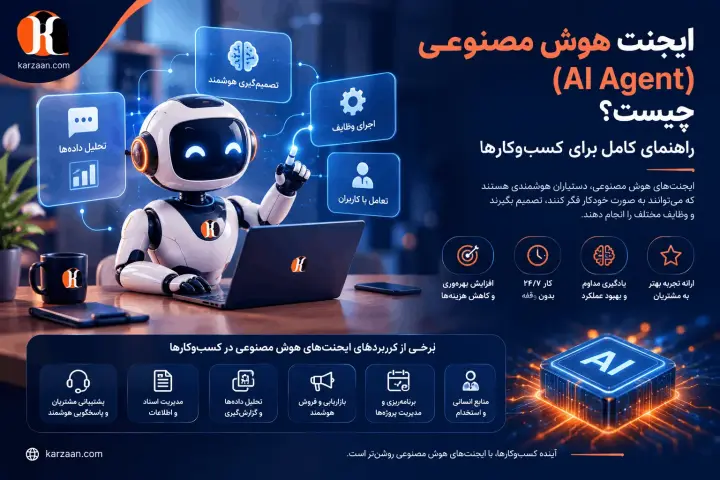 Article
What is an AI Agent? A Complete Guide for Businesses
Imagine having a smart assistant that not only answers your questions but autonomously makes decisions, uses tools, and completes complex tasks from start to finish — without constant guidance. This is exactly what AI Ag…
Read it-
01
What is an AI Agent? A Complete Guide for Businesses
-
02
 AI Agents in HR and Recruitment | Use Cases and Design
-
03
 AI Agents in Banking and Fintech | Use Cases and Design for Financial Organizations
-
04
 AI Agents in Oil, Gas and Petrochemicals | Use Cases and Design
-
05
 AI Agents in Insurance | Use Cases and Design
-
06
 AI Agents in Steel and Mining | Use Cases and Design
User Reviews
What users say about us
Post a New Review
No reviews have been posted for this project yet
Post a New Review
Send us your review