



.png)
AI Agents in Oil, Gas and Petrochemicals: From the Control Room to the Spare-Parts Warehouse
The oil, gas and petrochemical industry is one of the most data-driven and, at the same time, most high-risk industries in the world. A refinery or petrochemical complex generates thousands of data points every second from sensors, control systems and production equipment, holds thousands of pages of drawings, standards and technical procedures, and a single wrong decision can lead to a production stop, heavy losses or an incident. In this environment, an AI agent can act as a knowledgeable, always-available colleague: one that reads data, searches documents, offers analysis and helps engineers and technicians make decisions faster and with more confidence.

In our article What is an AI agent (in Persian) we explained the general concept, and in AI agents in banking and fintech (in Persian) we looked at their use in finance. This article is the second part of our "agents in industry" series and focuses on the energy sector: maintenance, operations, safety and HSE, engineering documents, supply chain and knowledge transfer. We also look at the special considerations of this industry, from industrial network security to working at remote sites, and the golden rule that an agent should advise, not directly control the process.
Why Does the Oil and Gas Industry Need AI Agents?
Oil, gas and petrochemical companies have invested in industrial automation for years; distributed control systems, SCADA and maintenance software are an inseparable part of the industry. But a large part of the knowledge and decision-making still lives in people's heads, in emails and in scattered documents. AI agents are a bridge between this data and these documents and the people who must make decisions based on them. For broader uses of AI in organizations, see our article Where should we use AI? (in Persian)
The main difference between an agent and earlier analytics tools is that an agent doesn't just display data: it understands the question, knows which system and which document to go to for the answer, puts the information together and presents the result in language an operator, technician or manager can understand and act on. In other words, an agent shortens the gap between "the data exists" and "the right decision was made", a gap that in the energy industry can sometimes be very costly.
Huge Volumes of Operational Data and Technical Documents
Every operating unit continuously records pressure, temperature, flow, vibration and dozens of other parameters. Alongside this data there are thousands of technical documents, including process drawings, equipment datasheets, operating procedures, inspection reports and maintenance records. The problem is not a lack of data; it is that finding the right information at the right time is very hard. An engineer who has to put together the repair history, datasheet and vibration trend of a pump to troubleshoot it can spend hours searching. An agent can do the same work in minutes.
Retirement of Experienced Staff and Knowledge Loss
A considerable share of the real knowledge in this industry is experiential: what sound a particular compressor makes before it fails, which setting works in winter, or why a certain procedure is carried out slightly differently from the official instruction. This knowledge sits in the heads of veteran experts and is lost when they retire. Agents can be a tool for capturing, organizing and making this knowledge available to the new generation of engineers and technicians.
Strict Safety and Environmental Requirements
In the energy industry, safety is an absolute priority. Work permits, risk assessments, inspections and environmental reports create a large amount of paperwork in which accuracy is vital. An agent can make this work faster and more consistent, point out gaps sooner and help HSE specialists spend more time in the field and less time behind a desk.
Agents in Maintenance
Maintenance is one of the most expensive parts of operations in oil and gas, and an unplanned stop of a key piece of equipment can take an entire unit offline. That is why maintenance is one of the highest-return areas for using agents.
Consider a real scenario: at three in the morning, the monitoring system shows a gradual rise in vibration on a transfer pump. The agent immediately reviews the vibration and bearing-temperature trends over the past few weeks, goes through the repair history of this pump and similar pumps, reads the manufacturer's datasheet and writes a summary for the shift technician: a likely bearing problem, the recommended inspection steps, the spare parts that may be needed and their stock in the warehouse. Instead of starting from scratch, the technician steps in with a clear picture and makes the final decision themselves.
Beyond predictive maintenance, an agent can also help improve the quality of maintenance data. Many repair records are logged with short, incomplete descriptions, which makes failure-cause analysis difficult. When a work order is closed, the agent can ask the technician follow-up questions and record the work description in a structured way, so there is reliable data for analysis in the future.
Analyzing Sensor Data and Predicting Failures
Predictive maintenance relies on analyzing sensor data to detect early signs of failure. Analytical models can detect unusual patterns, but the agent takes the next step: it interprets the alert, connects it to the equipment's history and documentation and explains in understandable language what may be happening and what action is recommended. This interpretation turns technical alerts from numbers on a screen into actionable information.
A Troubleshooting Assistant for Technicians
A technician standing at the equipment can ask the agent on a tablet or phone: "This control valve is oscillating; what should I check?". Drawing on the manufacturer's manual, repair history and recorded experience, the agent provides the troubleshooting steps one by one and, if needed, shows an image or the relevant part of a drawing. For this use case, designing an enterprise mobile app (in Persian) suited to industrial work, with a simple interface that can be used with gloves on, is very important.
Preparing Work Orders and Planning Maintenance
Based on alerts and inspection findings, an agent can draft a work order in full detail: the job description, required safety measures, parts and tools needed and an estimated duration. It can also help with turnaround planning; for example, by reviewing all open work orders, prioritizing them and suggesting groups of jobs that can be done during the same unit shutdown. These work orders ultimately need to be recorded in the organization's maintenance system or ERP software (in Persian), so integrating the agent with these systems is essential.
Agents in Operations and Process Control
The control room is the heart of every operating unit. Operators must monitor dozens of displays, respond to alarms and decide in the shortest possible time. In the control room, the agent is not a replacement for the operator but an assistant that lightens their mental load and gives them the information they need at the right moment.
For example, suppose a sudden drop in the outlet temperature of a heat exchanger occurs on the night shift. The operator asks the agent, "When did we last have a drop like this and what did we do?". Within seconds, the agent finds the history of similar events, the shift reports from those days, the related work orders and the relevant section of the operating procedure, and summarizes the actions taken and their results. With this information, the operator decides faster and with more confidence what to do or whom to inform.
Monitoring Indicators and Managing Control-Room Alarms
A well-known problem in control rooms is the "alarm flood": a situation in which many alarms go off at the same time and telling the main alarm apart from the consequential ones becomes difficult. An agent can group alarms, point to the likely root cause and pull the relevant response procedure from the operating instructions. The operator remains the decision-maker, but with a clearer picture and in less time.
Shift Reports and Shift Handover
Shift handover is one of the sensitive moments in operations, and incomplete information at this point can lead to mistakes. Based on control-system data, shift alarms, open work orders and operators' notes, an agent can draft the shift report and highlight important points such as equipment out of service, unfinished jobs and abnormal conditions. The operator only reviews and approves the report.
Optimizing Energy Use and Unit Performance
Process engineers are always looking to improve efficiency and reduce energy consumption. An agent can compare unit performance data across different periods, identify the conditions under which the unit performed best and explain the differences to the engineer. The engineer can ask in plain language, "Why was furnace fuel consumption higher last month?", and the agent analyzes the data and presents likely hypotheses with supporting evidence.
Agents in Health, Safety and Environment (HSE)
In oil and gas, the HSE department deals with a large volume of forms, permits, reports and inspections. Agents can reduce this department's paperwork while improving the quality and consistency of the work. Karzaan's experience designing the Zisa integrated HSE system shows that digitizing HSE processes provides the foundation needed to add an intelligent layer.
An important point in HSE use cases is that the agent must not reduce human presence and field supervision. The goal is for HSE specialists to spend more time in the workplace, talking to staff and doing real inspections, instead of hours on forms and reports. The agent lightens the documentation and analysis work so that safety culture is strengthened in practice.
Work Permits and Risk Assessment
Issuing work permits for activities such as hot work, confined-space entry or working at height requires a careful review of hazards and control measures. Based on the job description, its location and similar past jobs, an agent can draft the risk assessment, suggest the necessary controls and warn if another job is under way in the same area at the same time that conflicts with this one. The permit issuer remains responsible for final approval but works with a more complete and faster assessment.
Analyzing Incidents and Near Misses
Incident and near-miss reports are a treasure trove of valuable lessons, but they are usually recorded as free text and are hard to analyze. An agent can read these reports, categorize them, identify common root causes and reveal patterns that are not visible at first glance; for example, that a considerable share of a unit's near misses happen during shift handover or while contractors are working. These analyses help the HSE department target preventive actions more precisely.
Monitoring Compliance and Environmental Reporting
Energy companies must monitor and report data on emissions, waste and water use. An agent can gather data from various sources, compare it with permitted limits, warn earlier about values approaching the limit and prepare drafts of periodic reports. This reduces human error in calculations and shortens the time needed to prepare reports.
Agents in Technical and Engineering Document Management
A petrochemical complex or refinery may have tens of thousands of technical documents prepared over the years by different contractors. Finding the right revision of a drawing or the relevant clause of a standard takes up a lot of engineers' time every day. Knowledge agents are one of the fastest ways to create value in this industry.
The problem is not only the volume of documents; documents come in different formats (scanned files, CAD drawings, spreadsheets and text reports), are scattered across different systems, and several revisions of the same document are sometimes in circulation at once. A knowledge agent creates real value when it can handle this variety: read the text of scanned documents, tell the valid revision apart from old ones and rely only on approved documents in its answers.
Smart Search Across Drawings, Standards and Procedures
An engineer can ask in natural language: "What is the design pressure of the vessel in unit X, and when was it last inspected?" or "According to the company standard, what is the minimum safety distance for this type of work?". The agent finds the answer across the documents and always gives the exact source, including the document name, revision number and relevant clause, so the engineer can check it. In an industry where any wrong number can be dangerous, citing the source is not an optional feature but a requirement. These agents are usually made available to employees through the corporate portal (in Persian).
Document Control and Engineering Change Management
Every change to equipment or the process must be reflected in the related documents and go through the management-of-change process. By reviewing a change request, an agent can identify the documents likely to be affected, point out inconsistencies between documents and prepare a list of the revisions needed for the document-control team. This greatly reduces the risk of outdated, incorrect documents remaining in circulation.
Agents in the Supply Chain, Warehousing and Contracts
The supply chain in oil and gas deals with expensive parts, long lead times and many contractors. Missing a critical part during a repair can lengthen a shutdown, while buying more than needed ties up a lot of capital in the warehouse. To learn more about this area, see our article Supply chain management (SCM) software (in Persian).
In large energy companies, the item master can include tens of thousands of items, and the same part may be recorded in the system under several codes and descriptions. This leads to duplicate purchases and hidden stock. By understanding the technical descriptions of parts and comparing their specifications, an agent can identify duplicate codes and help clean up and standardize item data; without this, no inventory analysis will be accurate.
Forecasting Spare-Parts Demand
By reviewing consumption history, the upcoming turnaround schedule, predictive-maintenance alerts and suppliers' lead times, an agent can suggest parts orders. It can also identify slow-moving parts that haven't been used for years or suggest equivalent parts already in stock for a new request. These analyses become truly valuable when the agent has access to real warehouse and purchasing data through ERP integration (in Persian).
Reviewing Tender Bids and Contracts
Tender documents and contractors' technical bids are usually long and detailed. An agent can compare bids against the tender's technical requirements, list deviations and missing items and prepare an initial comparison table for the technical committee. During contract execution, it can also extract key obligations and deadlines and send reminders before they fall due. Deciding the tender winner and interpreting the contract legally remain with the specialists.
Agents in Training and Knowledge Transfer
Training in oil and gas is not just an HR activity; it is directly tied to safety and stable production. Agents can take training from the classroom to the workplace and preserve experiential knowledge before it is lost. For the basics of this area, read our article AI in corporate training (in Persian).
In many energy companies, a large part of the specialist workforce will retire in the coming years, and new staff must reach the required skill level in less time. This knowledge gap cannot be filled with classroom training alone. Combining structured knowledge capture, on-the-job training and smart assistants is a way to free the organization from heavy dependence on a few key individuals.
Capturing the Tacit Knowledge of Senior Experts
An agent can run a structured interview with a veteran expert; for example, ask about a particular piece of equipment, record the answers, ask follow-up questions and finally produce a well-organized knowledge document that is added to the knowledge base after the expert approves it. This is far easier than asking experts to write documentation and preserves knowledge that is not written in any official procedure.
Safety and Technical-Skills Training on the Job
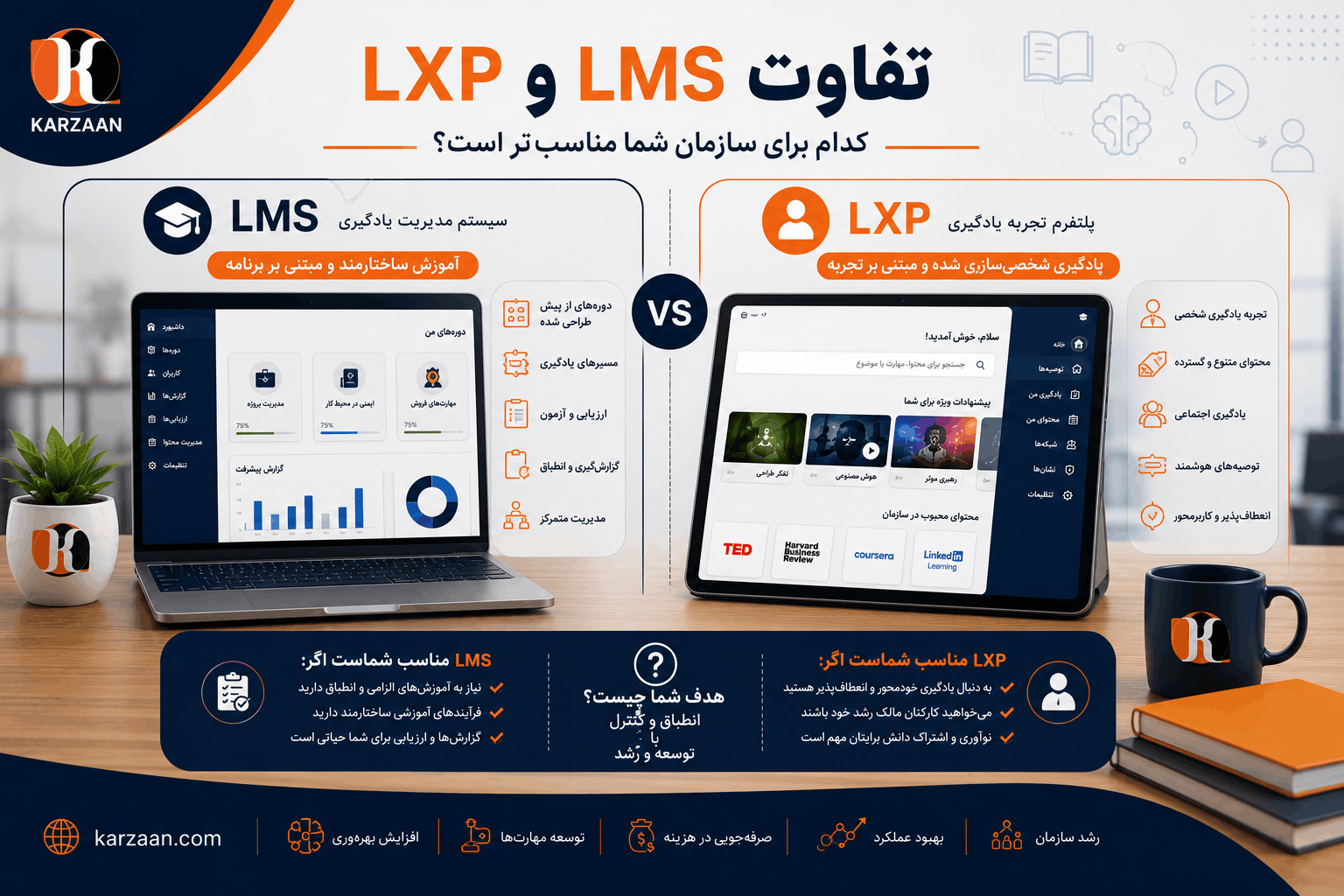
Staff at sites don't have time to attend long courses. Combining an agent with a learning experience platform (LXP) makes it possible to give each person short training tailored to their role, right before a task or after a safety event. Mandatory and certificate-based training is still managed through a learning management system; we explain the difference and how to combine the two in our articles What is an LXP (in Persian) and The difference between LMS and LXP (in Persian).
Industrial Agent Architecture: Special Considerations for the Energy Sector
An agent working in a refinery or petrochemical complex is fundamentally different from one working for an online store. The industrial environment has separate networks, strict security requirements, remote sites and serious safety consequences. The agent's architecture must be designed for these conditions from day one.
That is why, in this industry, a few questions must be answered before choosing a model or tool: What data does the agent need, and which networks is that data on? Who receives the agent's output, and what decision is made based on it? If the agent is wrong, what is the worst possible consequence? The answers to these questions determine the right architecture and the level of controls needed.
Connecting to Operational (OT) and Information (IT) Systems
An industrial agent usually needs two kinds of systems: operational-technology systems such as process data historians and condition-monitoring systems, and information-technology systems such as the maintenance system, ERP, document control and the HR system (in Persian). Connections to OT systems must be read-only and go through secure intermediary layers. Process data is usually replicated to the IT environment through a replication layer, and the agent works only with that copy, not with the control system itself.
Network Segregation and Industrial Cybersecurity
Industrial networks are targets of cyberattacks, and every new connection point is a potential risk. Deploying language models on the organization's own servers, keeping the agent off the internet in sensitive environments, precise access control and continuous log monitoring are basic requirements of these projects. The general security principles we covered in our articles Ways to improve security (in Persian) and How to prevent hacking (in Persian) are applied here with even greater rigor.
The Golden Rule: The Agent Advises, It Doesn't Control
In the energy industry, an AI agent should never send commands directly to the process control system. Its role is to analyze, explain and recommend, and any action on equipment or the process must be carried out by an authorized operator or engineer through standard procedures. This boundary must be clearly defined both in the technical architecture (no write access to the control system) and in the organization's procedures. Following this rule keeps safety risk under control and makes it easier for operators to accept the agent.
Working Offline and at Remote Sites
Many platforms, compressor stations and operating sites are in remote areas with limited network connectivity. For these environments, the agent's architecture must allow local operation; for example, a lightweight version of the knowledge base and model running on the site's local server that syncs with headquarters whenever a connection is available. Likewise, technicians' mobile app must offer offline access to procedures and checklists.
A Roadmap for Implementing Agents in Oil and Gas Companies
Large energy companies have complex structures, many units and a conservative culture, which is entirely reasonable for a high-risk industry. That is why implementing agents must be gradual, measurable and involve end users.
One of the key success factors at this stage is forming a joint team of representatives from operations, maintenance, HSE, IT and cybersecurity. This team prioritizes use cases, defines the limits of the agent's authority and gathers user feedback during the pilot. Visible support from senior management and naming a few lead users in each unit also help a great deal with faster adoption.
Choosing the Pilot Use Case
The best pilots are usually those that take up the most specialist time and carry the least safety risk. A technical-document search assistant, drafting shift reports and analyzing near-miss reports are good examples, because their output is always reviewed by a person and their value becomes visible quickly. Use cases closer to operations, such as interpreting control-room alarms, are best rolled out in later phases once trust has been built.
Preparing Data and Documents
An agent's quality depends directly on the quality of the data and documents it is given. Before launch, identify key documents, set aside obsolete revisions, convert scanned documents into searchable text and assign an owner to each group of documents who is responsible for keeping it up to date. This stage is sometimes the most time-consuming part of the project, but without it no agent can give reliable answers.
Expanding to Other Units and Sites
After a successful pilot in one unit, document the lessons learned, standardize settings and guardrails and gradually extend the agent to other units and sites. Each site may have its own documents, equipment and procedures, so the architecture must allow local knowledge bases to be added alongside the organization's shared knowledge. At this stage, creating an internal team to maintain and develop the agents ensures the project's sustainability.
Metrics for Measuring Agent Success in the Energy Sector
To show senior managers the agent's value, define specific metrics from the start and record the current baseline:
- Time to find information: less time spent by engineers and technicians looking for the documents or data they need.
- Troubleshooting and repair time: a shorter interval between an alarm and identifying the cause and completing the repair.
- Unplanned downtime: the trend in the number and duration of unplanned stops of key equipment.
- Report quality: completeness and consistency of shift, inspection and HSE reports.
- Leading safety indicators: more near-miss reporting and faster closing of corrective actions.
- Usage and user satisfaction: the number of active users and feedback from operators, technicians and engineers.
We recommend tracking these metrics monthly in a simple dashboard and presenting the results to managers together with real examples, such as a troubleshooting case where the agent sharply shortened the time needed. Real stories alongside the numbers are the best way to win support and extend the project to other units.
Common Mistakes in Industrial Agent Projects
- Giving the agent control access: any write access to the process control system is an unacceptable risk.
- Starting without cleaning up documents: an agent that answers from obsolete drawings and procedures loses users' trust for good.
- Ignoring front-line users: an agent designed without operators and technicians usually isn't used in practice.
- Answers without sources: in the energy industry, every technical answer must be traceable to the original document.
- Neglecting industrial cybersecurity: careless connections between IT and OT environments can open a new path for intrusion.
- Expecting instant results across the organization: starting small and expanding gradually is a safer path than rolling out to every unit at once.
Why Karzaan for Designing Industrial Agents?
Karzaan has experience designing and delivering large-scale enterprise software (in Persian), from HSE systems and corporate portals to extensive learning systems such as the University of Tehran applied and professional training system. Karzaan's AI team designs agents with an architecture that can be deployed on the organization's own servers, full support for Persian and guardrails suited to industrial environments, and connects them to existing systems such as ERP, the maintenance system and document control.
Our services include process review and use-case selection, knowledge-base preparation, secure architecture design, pilot delivery, user training and post-launch support. Karzaan's LXP can also work alongside the agents to make safety and technical-skills training for staff intelligent. To see our work, visit our projects page, and for all our services, see Karzaan's services.
Working with Karzaan usually starts with a process-review workshop. In this workshop, together with representatives from operations, maintenance, HSE and IT, we identify frequent and time-consuming tasks, assess the available data and documents and choose one or two use cases for the pilot. The output is a clear roadmap with measurable goals that managers can base their decisions on.
Conclusion
AI agents can create real, measurable value in the oil, gas and petrochemical industry: shorter troubleshooting and repair times, a lighter mental load for operators, faster HSE work, quick access to technical documents, a smarter supply chain and preservation of veteran experts' valuable knowledge. But in this industry success depends on a few principles: the agent advises and does not control, every answer cites a reliable source, industrial cybersecurity is considered from day one, and implementation starts with a low-risk pilot and expands gradually.
If your company works in oil, gas, petrochemicals or energy and wants to see where AI agents can create the most value, Karzaan's experts are ready to review your processes and propose a suitable roadmap. For a free consultation, get in touch through our contact page.