


.png)
AI Agents in Banking and Fintech: From Answering Questions to Supporting Decisions
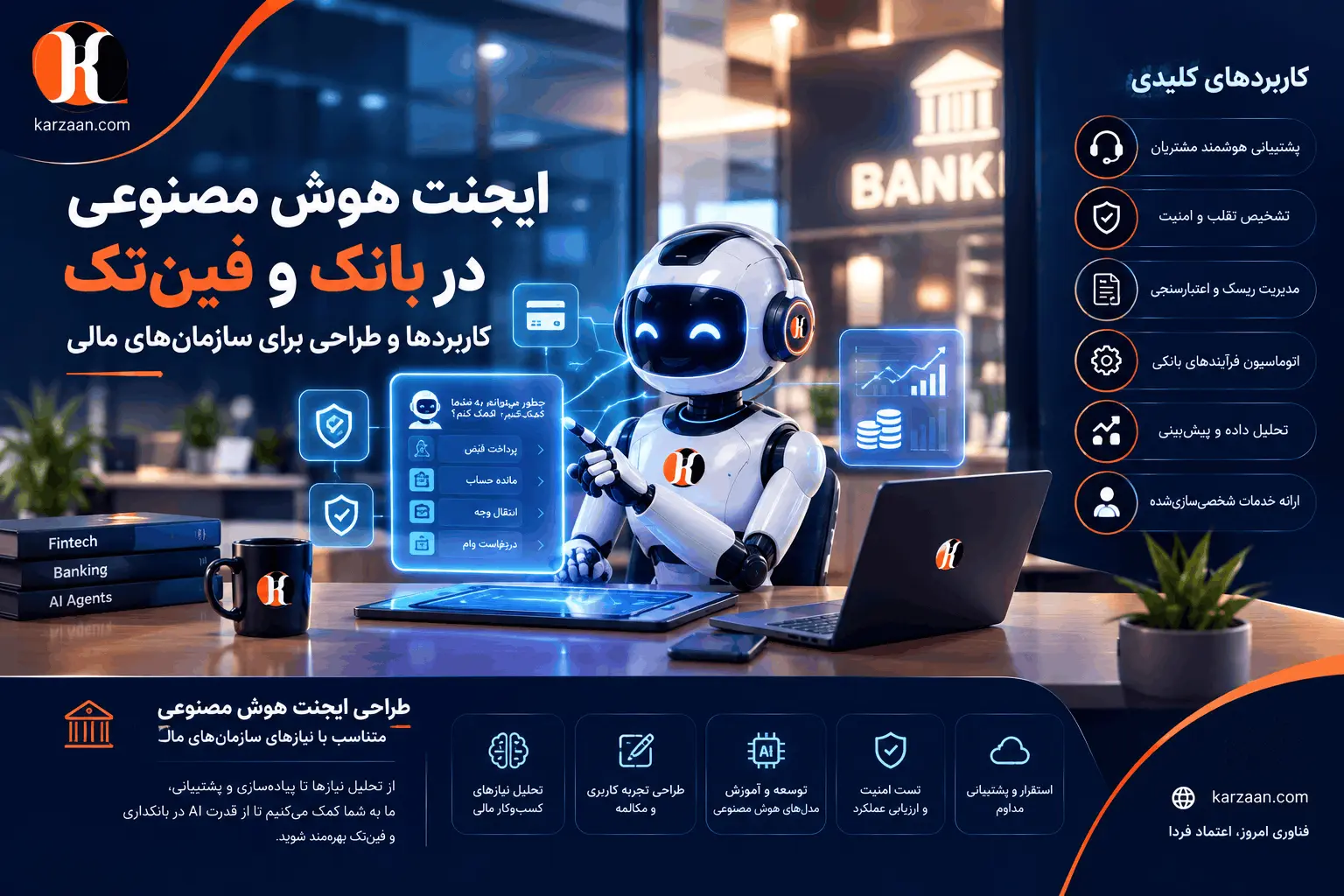
Banks and payment companies deal every day with a huge volume of transactions, customer requests, credit files and security alerts. Much of this work is repetitive, time-consuming and depends on searching across several different systems; exactly the kind of work an AI agent is built for. Unlike a simple chatbot, an agent does not just reply: it can gather information from different systems, carry a multi-step process forward, propose a decision and, at sensitive points, hand the work to a human for approval.

If you are not yet familiar with the concept of an agent, we suggest first reading our article What is an AI agent (in Persian). In this article we focus on one specific industry: banking, payments and fintech. We look at exactly where agents are useful in a bank or payment company, what the architecture of a secure banking agent looks like, which security and data-privacy requirements must be met, and how a financial organization can design and launch its first agent step by step.
Why Do Banks and Payment Companies Need AI Agents?
The financial industry was one of the first to embrace automation, from ATMs to internet and mobile banking. But a large part of the back-office work still depends on people: answering repetitive questions, reviewing disputes, matching documents, analyzing alerts and preparing reports. AI agents are the next generation of this automation; automation that, instead of executing fixed rules, can understand natural language, work with messy data and make sensible decisions in new situations too. For an overview of the industry, our article What is fintech (in Persian) is a good starting point.
High Volumes of Transactions and Customer Requests
Every large bank or payment company receives a large number of calls, messages and tickets each day, and a significant share of them are repetitive: "Money was deducted but the purchase didn't go through", "Why is my card blocked?", "What is the status of my loan application?". Answering each of these usually requires searching several systems. When request volumes rise, queues grow longer, customer satisfaction drops and contact-center costs climb quickly. An agent can resolve a large share of these requests completely, without human involvement.
Competitive Pressure from Fintechs and Digital Customer Expectations
Today's customers use apps that answer in seconds. When a small fintech can open an account or grant a micro-loan in minutes, a bank that needs several days for the same task loses the customer. The different types of fintech we review in our article Types of fintech and their applications (in Persian) all rely on speed and user experience, and AI agents are one of the main tools for achieving that speed, both for fintechs that want to grow and for banks that don't want to fall behind.
How Agents Differ from Older Banking Chatbots
Many banks have experience with scenario-based chatbots: bots that recognize only a few predefined questions and, at the first question outside the script, send the user to "contact support". An AI agent differs in three fundamental ways. First, it understands what the user means, even when it is written in colloquial language with spelling mistakes. Second, it has access to tools and can look up the real status of a transaction or case. Third, it can carry out a multi-step task, such as filing a dispute and following it up, from start to finish.
| Feature | Scenario-based chatbot | AI agent |
|---|---|---|
| Language understanding | Predefined keywords | Understands natural and colloquial language |
| Data access | Limited or none | Queries the bank's systems through APIs |
| Getting things done | Text replies only | Runs multi-step processes |
| Handling new situations | Hands off to an operator | Reasons and proposes a solution, with smart hand-off when needed |
AI Agents in Bank Customer Service
Customer service is the most common and lowest-risk starting point for an agent in a bank. Here, the agent can work in the mobile app, on the website, in messaging apps and even in the phone contact center (using speech-to-text). The key point is that a customer-service agent should work in the channel the customer already uses, which is why its design usually goes hand in hand with payment app design (in Persian) or banking app design.
Picture a simple scenario: at eleven at night, a customer writes in the bank's app, "Money was taken from my card but I didn't get the top-up." After verifying their identity, the agent checks the card's transactions from the past few hours, finds the failed transaction, explains that the amount is in automatic reversal and gives the approximate time it will be returned. If the automatic reversal window has passed, it files a dispute on the spot and provides a tracking number. All of this happens without the customer waiting until morning for the contact center to open, and a specialist only steps in when a human decision is really needed.
24/7 Support and Transaction Tracking
The most common question bank customers ask is about the status of their transactions. After authenticating the user, the agent can take the tracking number or approximate time of the transaction, look up its status in internal systems and explain in simple terms what happened; for example, how long it will take for a deducted amount to be returned automatically, or that the transaction succeeded and here is the receipt. This single capability can remove a considerable share of the contact-center workload and save customers from waiting on hold.
Handling Disputes and Transaction Discrepancies
When a transaction really does have a problem, the agent can also run the dispute process: ask the customer for the necessary information, receive documents (such as a screenshot of the receipt), register the case in the system with full details and issue a tracking number. Next, another internal agent can match the case against switch and settlement data and prepare a draft finding for the specialist. The result is a dramatically shorter handling time and fewer human errors in case registration.
Smart Hand-Off to a Human Specialist
A good agent knows where it should not decide on its own. If the customer is angry, if the matter involves a large amount or a legal complaint, or if the agent is not confident enough in its answer, it should pass the conversation to a human specialist, together with a full summary of the conversation and the information gathered so far, so the customer doesn't have to explain everything again. This "smart hand-off" is one of the most important factors in customer satisfaction with AI-based systems. Recording these interactions in a CRM system (in Persian) also keeps the full history of every customer relationship in one place.
Agents in Fraud Detection and Risk Management
Fraud detection has been done with machine-learning models for years, but agents add a new role to this field: they don't just produce a risk score, they review the case, put the evidence together and suggest the next action. This difference matters a great deal to security and risk teams that face a large number of alerts every day.
Monitoring Transactions and Spotting Suspicious Patterns
Analytical models monitor transactions continuously and flag unusual patterns: repeated purchases from unfamiliar merchants, a transaction from a new device or location, or a sudden change in an account's behavior. The problem is that many of these alerts are false positives and the human team does not have time to review them all. An agent can act as a "first-level analyst" and screen each alert before it reaches a person.
Reviewing Suspicious Cases and Recommending Actions
When an alert is raised, the agent gathers the account history, related transactions, device information and the customer's previous records, writes an understandable summary of the case and recommends the appropriate action: closing the case as a false positive, calling the customer to confirm, or a temporary block. The final decision on sensitive actions still rests with the specialist, but the time spent on each case drops sharply and the team can focus on the truly high-risk cases.
Anti-Money Laundering and Know Your Customer (KYC)
Know-your-customer and anti-money-laundering processes are full of document work: checking identity documents, matching information against lists, analyzing the source of funds and preparing regulatory reports. An agent can read documents, highlight inconsistencies, ask the customer for missing information and prepare a draft report for the compliance unit. In this area, fully recording the agent's reasoning behind each decision is especially important, because the bank must be able to explain to the regulator why it judged a case suspicious or normal.
Agents in Credit Scoring and Lending
Lending is one of the slowest and most expensive banking processes. From receiving an application to reviewing documents, scoring, setting a limit and following up repayments, many specialists are involved. Agents can play a role at every step of this chain and noticeably shorten the time from application to decision, which is vital for micro-credit products and credit cards.
Collecting and Analyzing Applicant Documents
In a simple conversation, an agent can collect the required information from the applicant, read uploaded documents such as payslips, statements or business licenses, extract the key information and point out anything missing right away. This prevents long back-and-forth between the branch and the customer and delivers a complete, standardized file to the credit specialist.
Recommending Credit Limits and Suitable Products
By combining transaction-behavior data, repayment history and the credit-score result, an agent can make an initial recommendation for the credit limit, product type and repayment terms. This recommendation must be based on the bank's defined credit policies and must be explainable; the agent should say on what basis it suggested the limit. The final decision on larger cases still lies with the credit committee, but for micro products a large part of the process can be automated within clear rules. Karzaan's experience designing the Aramis credit card system shows that designing the credit rules correctly before automating is the main condition for success.
Repayment Follow-Up and Collections
After a loan is granted, the agent can send personalized installment reminders, answer the customer's questions about their outstanding balance and, for customers who are struggling to pay, present permitted options such as rescheduling within the bank's policy. The tone and timing of these messages matter a lot; the agent must be respectful, accurate and suited to each customer's situation, and hand sensitive cases to a collections specialist.
Agents in Payment Service Providers (PSPs) and Payment Facilitators
Payment service providers and payment facilitators deal with two groups of customers: merchants (shops and businesses) and cardholders. On top of that, they must continuously monitor complex technical infrastructure. AI agents are useful in all three areas. To learn more about this part of the industry, also see our article Types of fintech and their benefits (in Persian).
An important difference between payment companies and banks is that many of their customers are businesses themselves, and every disruption directly hurts their sales. That is why agents in these companies must be both fast and technically precise about terminals, gateways and the settlement process. In practice, the best results come when agents are built on the same data and APIs the operations team works with every day.
Smart Merchant Support
Merchants ask many repetitive questions: "When will today's settlement be paid?", "Why is my terminal declining transactions?", "How do I connect the payment gateway to my website?". With access to settlement data, terminal status and technical documentation, a merchant-support agent can answer most of these questions instantly, walk the merchant through troubleshooting step by step and open a technical ticket only when needed. For small businesses, where every minute of payment downtime means lost sales, this speed is very valuable.
Monitoring Network Health and Transaction Routing
In payment infrastructure, the quality of connections to banks and networks changes constantly. Transaction routing systems, like the project Karzaan delivered for Fanap, send each transaction down the best route based on rules and performance indicators. An agent can be a layer above these systems: it monitors success rates and response times, detects a route's drop in quality earlier than a person would, analyzes the likely cause from the logs and suggests routing-rule changes to the operations team. In this area the agent usually recommends, and the final change is applied with human approval.
Settlement and Reconciliation
Reconciling transactions recorded in the payment system with bank reports and settlement files is one of the most time-consuming tasks in finance departments. An agent can match the files, categorize discrepancies, identify the likely cause of each one and prepare a draft correcting entry for fixable items. This speeds up closing the books and reduces the chance of human error in repetitive calculations.
Agents in Customer Clubs and Loyalty Systems
Loyalty systems and customer clubs generate a large amount of behavioral data that is usually underused. Agents can turn this data into action, both for end customers and for the marketing team. Karzaan became closely familiar with the challenges of this field while designing the Parseh discount and loyalty switch.
Personalized Offers for Customers
Based on each customer's purchase history and points, an agent can present relevant offers, answer questions about points and rewards and even suggest the best way to use points at the moment of purchase. The difference from mass promotional text messages is that the offer arrives at the right time, in the right channel and matches the customer's real needs, so it is far more likely to have an effect.
Designing and Monitoring Campaigns for the Marketing Team
For the marketing team, the agent acts as an always-available analyst: a specialist can ask in plain language, "What do customers whose spending has dropped over the past three months have in common?" or "How did last week's campaign perform in different cities?", and the agent runs the queries on the data and returns the answer with a table and analysis. The agent can also prepare a draft of the next campaign, including audience segments and message text, for the team to review.
Internal Agents for Bank Employees
An important part of the value of agents in a bank is created not for customers but inside the organization. Branch staff, contact-center agents and head-office teams spend a lot of time every day finding information and doing repetitive admin work. Internal agents usually carry less risk than customer-facing ones and are a very good place to start. These agents are typically made available to employees through the bank's corporate portal (in Persian).
A Knowledge Assistant for Procedures and Circulars
Banks have a large volume of procedures, circulars and regulations that are constantly updated. To answer a simple question like "What documents are needed to open a corporate account?", a branch employee sometimes has to search several documents or call head office. A knowledge assistant, drawing on an up-to-date collection of internal documents, gives the precise answer with a reference to the relevant clause and document. Citing the source is vital in these agents; the employee must be able to check the answer quickly.
Training and Empowering Branch Staff
Every time a new product is launched or a regulation changes, staff across a wide branch network need to be trained quickly. Learning agents can deliver short content tailored to each employee's role, answer their questions and measure how ready the branches are. This is exactly what an AI-powered learning experience platform (LXP) does; to learn more, read our articles What is an LXP (in Persian) and AI in corporate training (in Persian).
The Architecture of a Secure Banking Agent
Designing an agent for a bank is fundamentally different from designing a general-purpose chatbot. In a bank, a wrong answer or an unauthorized action can have financial and legal consequences. That is why a banking agent's architecture must be built from the start on control, transparency and least privilege. A standard banking agent has four main layers.
The Language Model and the Knowledge Layer (RAG)
The language model is the agent's brain, responsible for understanding the request, reasoning and generating the answer. But on its own, a language model knows nothing about your bank's rules, products and procedures and may make up an incorrect answer. The solution is retrieval-augmented generation (RAG): before answering, the agent retrieves the relevant documents from the bank's internal knowledge base and builds its answer only from those documents. Keeping this knowledge base up to date and assigning an owner to each group of documents is an important part of the project.
Tools and Connections to Core Banking and the Switch
An agent's real power comes from its tools: the APIs that let it look up a transaction's status, open a ticket or read customer information. In a bank, these tools must connect to core banking, the switch, the card system, the CRM and other systems through a secure middleware layer, not through direct database access. The integration principles we explain in our article ERP integration (in Persian) apply here too: each tool should do exactly one clearly defined job, its inputs should be validated and its output should be standardized.
Guardrails, Access Levels and Human Approval
Every banking agent should work with the least privilege it needs. A customer-service agent should see only the data of the authenticated customer, and a reporting agent should not be able to change data. In addition, guardrails are needed to prevent out-of-scope answers, disclosure of sensitive information and execution of malicious instructions hidden in user input. For every sensitive action, such as blocking a card, refunding money or changing account details, an explicit confirmation step by the customer or a specialist must be built into the process.
Logging, Auditing and Explainability
In finance, the "why" matters as much as the "what". Every conversation, every tool the agent called and every decision it made must be fully recorded so that audit, compliance and security teams can review it at any time. The agent must be able to give an understandable reason for its recommendations; this is essential both for employees' trust and for answering to regulators.
To make sure these logs cannot be altered, some financial organizations use append-only storage or even distributed-ledger technology, a topic whose uses and limits we cover in our article Blockchain in business (in Persian). Even without blockchain, keeping logs in an environment separate from the operational system and with restricted access is the minimum requirement.
Security and Data-Privacy Requirements for Iranian Banks
Iranian financial organizations face special conditions when using AI: restricted access to some foreign services, the high sensitivity of financial data and the requirements of supervisory bodies. These conditions must be part of the design from day one, not added after the agent is built. The general security principles discussed in our articles Ways to improve website security (in Persian) and How to prevent your site from being hacked (in Persian) are the foundation, but agents bring new considerations too.
On-Premises Deployment and Data Residency
For most banks and payment companies, sending customer data to foreign cloud services is not acceptable. The solution is to use language models that can be deployed on the organization's own servers, or architectures that anonymize sensitive data before any external processing. The choice between these options depends on how sensitive each use case is; an internal knowledge agent that works only with the bank's general documents has different requirements from a fraud-detection agent that handles transaction data.
Regulatory Compliance and Oversight
Any agent involved in financial processes must comply with central bank regulations, payment network requirements and the bank's internal policies. We recommend involving the compliance and legal teams from the start of the project in designing scenarios, defining the limits of the agent's authority and deciding how logs are kept. This early involvement prevents costly redesigns at the end of the project.
A Roadmap for Designing and Implementing Agents in a Financial Organization
The biggest mistake in banking AI projects is starting with the most ambitious scenario. The successful path usually starts with a specific, low-risk, high-frequency use case and, once its value is proven, expands gradually.
Choosing the First Use Case
To choose your first agent, consider three criteria: volume (work that repeats often), risk (mistakes have no serious financial consequence) and data access (the necessary information exists in systems and can be connected). By these criteria, an internal knowledge assistant for employees, answering frequent questions about transaction status, and merchant support are usually the best starting points. Decision-making agents in credit and risk are best tackled in a second phase, after gaining experience.
A useful exercise at this stage is a short workshop with representatives from the contact center, branches, operations, IT and compliance. In it, the team lists each department's repetitive tasks, scores each one on volume, risk and data access, and picks the two or three highest-scoring items for the pilot. The output of this workshop clarifies the project roadmap and wins the support of key departments from the very beginning.
Pilot, Measure and Expand
Launch the agent first for a small group of users or employees. At this stage, review every answer, categorize errors and refine the knowledge base and guardrails. Once quality reaches an acceptable level, widen the user base and add new tools to the agent. Experience shows that agents built with this gradual approach win employees' trust sooner and reach full operation with less risk. If the agent is going to be available in the bank's mobile app, also apply the considerations from our articles Enterprise mobile app design (in Persian) and Enterprise UI/UX design (in Persian) to the design of the conversation experience.
Metrics for Measuring a Banking Agent's Success
To evaluate an agent, define the metrics and record the current baseline before launch. Suggested metrics are:
- First-contact resolution rate: the share of requests the agent resolved completely without handing off to a person.
- Handling time: the average time from a request or alert being raised to it being closed, before and after the agent.
- Answer accuracy and quality: the percentage of correct answers in regular samples reviewed by specialists.
- Customer satisfaction: the score customers give after a conversation with the agent.
- Specialist workload: the change in the number of cases needing human review and the team's focus on complex cases.
- Risk metrics: for fraud and compliance agents, fewer false positives and faster detection of real cases.
Common Mistakes in Banking Agent Projects
- Too much access: giving the agent broad access "for convenience" is the biggest security risk in these projects.
- An outdated knowledge base: an agent that answers from obsolete circulars is worse than no agent at all.
- Removing people entirely: in sensitive financial processes, human approval must be part of the design, not an exception.
- Ignoring the compliance unit: bringing legal and compliance in late usually leads to the project being halted or redesigned.
- No logging or auditability: without a full record of decisions, answering to the regulator and fixing errors is almost impossible.
- Focusing only on technology: an agent's success depends as much on redesigning the process and training staff as on the language model.
Why Karzaan for Designing Banking and Payment Agents?
Karzaan has worked in payment and fintech software for years, and our team has worked closely with infrastructure such as payment switches, transaction routing, payment facilitation, credit systems and customer clubs, including in projects such as Parseh payment facilitation. This experience means the agents we design are not just a presentation layer but are genuinely connected to operational systems and work in line with the business logic of payments. Alongside this experience, Karzaan's AI team designs agents with a security-first approach, on-premises deployment options and full support for Persian.
Our services in this area include process analysis and use-case selection, architecture and guardrail design, connecting the agent to the bank's or payment company's systems, running the pilot and post-launch support. To see our work, visit our projects page, and to learn about our other services, see Karzaan's services.
Conclusion
AI agents are becoming an inseparable part of the infrastructure of banks and payment companies, from customer support and merchant help to fraud detection, credit scoring, reconciliation and employee enablement. But in finance, success does not depend only on how smart the model is; secure architecture, least privilege, human approval at sensitive points, full recording of decisions and regulatory compliance matter just as much. An organization that starts with a specific use case, measures its value and expands gradually can get the most out of this technology with the least risk.
If your bank, payment company or fintech is looking to design an AI agent, Karzaan's experts are ready to review your processes and suggest the best starting point. For a free consultation, get in touch through our contact page.