

AI Agents in Online Stores and Customer Support | Use Cases and Design
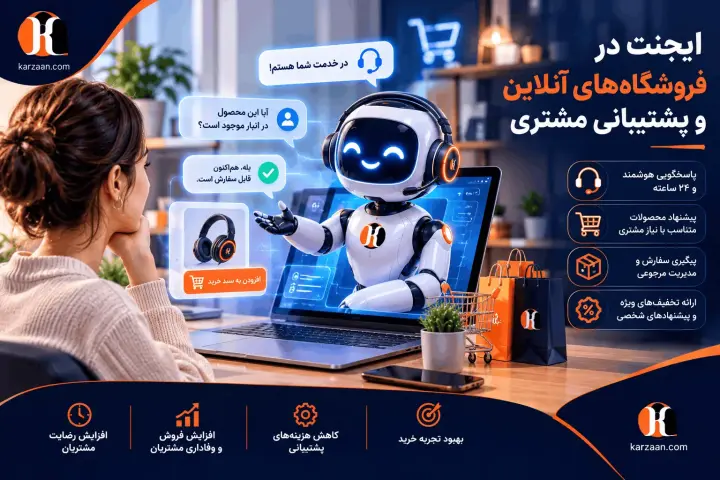
An online store is open around the clock, but its support usually answers only a few hours a day. Customers who get no answer buy from a competitor, and the support team is worn out by repeated messages about order status, shipping, returns and failed payments. AI agents can fill this gap, not just by answering but by connecting to orders, the warehouse, the payment gateway and the customer system and actually doing the work. In this article we review agent use cases across the whole customer journey, from shopping advice and smart search to after-sales support, abandoned carts, catalog management, stock and loyalty, give examples for different types of stores, explain the technical architecture and risks, and propose a practical roadmap for getting started.
In this article
- 01 Why do online stores need AI agents?
- 02 Mapping agents onto the customer journey
- 03 The shopping advisor agent: a salesperson who is always there
- 04 The customer support agent: the highest volume, the fastest return
- 05 The abandoned cart and failed payment agent
- 06 The catalog and product content agent
- 07 The inventory, pricing and supply agent
- 08 The marketing and customer loyalty agent
- 09 Agent use cases in different types of online stores
- 10 The technical architecture of a store agent
- 11 Risks and critical points
- 12 Implementation roadmap
- 13 How do you measure a store agent’s success?
- 14 Conclusion and next steps with Karzaan
AI agents in online stores: from shopping advice to after-sales support
On paper an online store is open around the clock, but in practice its support answers only a few hours a day. A customer asks at eleven at night whether a phone is compatible with their old charger, gets no answer and buys from another store. Another customer has been waiting three days for an order and calls five times to find out the shipping status. Meanwhile the support team is drowning in dozens of repeated messages about shipping costs, returns and discount codes. AI agents are built for exactly this gap: systems that don’t just answer, but connect to orders, the warehouse, the payment gateway and the customer system, and actually get the work done.
This article is the sixth part of our “Agents in industry” series. If you are not familiar with the concept of an agent, first read What is an AI agent? (in Persian). In the previous part we looked at AI agents in human resources (in Persian), and this time we turn to e-commerce. Below we review agent use cases across the whole customer journey, from product search to after-sales support, give examples for different types of stores, explain the technical architecture and risks, and propose a practical roadmap. If you own or manage an online store, this guide helps you know where to start and what to expect from Karzaan’s AI services.
Why do online stores need AI agents?
Having an online store is no longer a competitive advantage; almost every competitor has one too. In Why should you have an online store? (in Persian) we covered the reasons for being online, but today the main difference lies in the customer experience: how quickly customers get an answer, how easily they find the right product and how fast a problem is solved when something goes wrong.
Most stores get stuck at this point. As sales grow, the volume of questions and requests rises faster than the support team’s capacity. Hiring more staff is costly and creates idle capacity in quiet seasons. An AI agent makes this capacity flexible: at peak times it handles hundreds of conversations at once, and in quiet periods it costs nothing extra.
Support pressure in busy seasons
Every online store has several sales peaks a year: the new year holidays, discount festivals, the start of the school year or the launch of a popular product. On these days the volume of messages multiplies, and that is exactly when slow replies do the most damage, because the customer is ready to buy and, without an answer, goes to a competitor.
A large share of the messages on these days are repetitive: “When will my order arrive?”, “The discount code doesn’t work”, “Money was taken from my account but the order wasn’t placed.” These questions have definite answers that already exist in the store’s systems. An agent with access to those systems can resolve most of them without human involvement and leave the support team free for complex cases.
How an agent differs from old-style store chatbots
Many stores have already installed a live chat tool or a simple chatbot and didn’t have a good experience. The old chatbot was a button menu that walked customers around a few fixed paths, and if the question was slightly different it just said “I didn’t understand.” Customers quickly learned to look for the “talk to an operator” button.
An AI agent differs in three main ways. It understands natural, even colloquial, language full of typos. It takes several steps to reach a goal; for example, for “I want to change my order” it first checks the order status, then the exchange rules, and finally logs the request. And it uses tools, meaning that instead of sending a help link it does the work itself. To see where AI creates the most value in a business, read Where should we use artificial intelligence? (in Persian).
Mapping agents onto the customer journey
The best way to design store agents is to look at the customer journey, from the moment a customer searches for a product until long after the purchase. At each stage a specific agent can help:
| Stage | Suggested agent | Main output |
|---|---|---|
| Search and selection | Shopping advisor agent | Finding the right product and an honest comparison |
| Purchase and payment | Cart and payment agent | Fewer abandoned carts and resolved transaction problems |
| After purchase | Support agent | Order tracking, returns, exchanges and warranty |
| Behind the scenes | Catalog agent and inventory agent | More accurate product content and timely stock |
| Customer return | Marketing and loyalty agent | Personal messages, loyalty club and repeat purchases |
These agents don’t all need to be built at the same time. Successful stores usually start with the support agent, because it carries the most workload and the fastest return on investment, and then move on to the others.
The shopping advisor agent: a salesperson who is always there
In a physical store, a good salesperson works out with a few simple questions what the customer really wants and shows them the right product. In an online store this role is usually empty, and customers have to find their own way among hundreds of products and filters. The shopping advisor agent fills this gap.
Understanding the customer’s need through conversation
Customers often don’t know exactly which model they’re looking for; they only know they want “a light laptop for an architecture student on a mid-range budget.” With a few short questions the advisor agent pins down the need: which software will it run? How often will it be carried around? Does screen size matter? It then suggests a few genuinely suitable options from the catalog.
This conversation is valuable for the store too. The store learns what needs customers arrive with and which needs the current catalog doesn’t meet. This data is very useful for purchasing decisions and campaign design.
Comparing products and honest recommendations
The agent can compare two or three products on the features that matter to that particular customer and explain the differences in plain language. The key point is honesty: if a cheaper product is enough for the customer’s need, the agent should recommend that one. A customer who feels misled never comes back, but one who got the right advice becomes loyal.
To prevent wrong information, the agent must use only the product specifications recorded in the catalog and, wherever information is insufficient, say so honestly or refer the question to an expert. We explain this further in the risks section.
Smart catalog search
Traditional store search depends on exact words. If a customer types “comfortable shoes for long walks” and that phrase isn’t in any product title, they get no results. With semantic search the agent understands what the customer means and finds products whose features fit, even if different words appear in their descriptions.
This capability makes a serious difference especially for large stores with thousands of items. Search quality has a direct effect on the conversion rate and, alongside the points in online store design (in Persian), is one of the most important sales factors.
The customer support agent: the highest volume, the fastest return
The support agent is usually the best starting point. A large share of support requests in stores comes down to a few topics: order status, shipping cost and time, returns and exchanges, warranty and payment problems. All of these topics have definite data in the store’s systems.
An important point in designing this agent is tone. A customer messaging to track an order is usually somewhat worried or unhappy. The agent should answer briefly, clearly and with empathy, avoid technical jargon and clichés, and honestly admit it if the store is to blame for a delay. These small details make the difference between an annoying experience and a trustworthy one, and make the customer buy from the same store again even after a problem.
Order and shipping tracking
When a customer asks “Where is my order?”, the agent verifies their identity with their mobile number or order number, reads the order status from the store system and the tracking code from the courier, and gives a precise answer. If the order has fallen behind the promised time, the agent can inform the customer itself before they even ask.
This proactive notification is one of the most effective ways to reduce calls and raise satisfaction. A customer who has been told about a delay is far less unhappy than one left in the dark.
Returns, exchanges and warranty
The returns process is confusing for many customers: can this item be returned? How many days is the window? Who pays for shipping? By checking the delivery date, item type and store rules, the agent gives a precise answer and, if the conditions are met, logs the return request and arranges the pickup time.
For warranty, the agent can check the serial number and purchase date, determine whether the warranty is valid and direct the customer to the right service center. Exceptional decisions, such as accepting a return outside the window, must be left to a human specialist.
Handing over properly to a human operator
A good agent knows when to step aside. Serious complaints, angry customers, damaged high-value items or compensation requests are cases that must reach a human. What matters is that this handover is painless: the agent gives the operator a summary of the conversation, the order information and what has been done so far, so the customer doesn’t have to tell the story from the start.
This information is best recorded in the store’s CRM software (in Persian), so the complete history of contact with each customer is in one place and any operator who talks to them later knows the background.
The abandoned cart and failed payment agent
A significant share of customers add items to the cart but don’t complete the purchase. The reason may be an unexpected shipping cost, doubts about the product, a problem with the payment gateway or simple distraction. In The effect of a website on sales (in Persian) we explained how much every small obstacle on the purchase path reduces sales. An agent can win back some of these lost sales.
Smart follow-up on abandoned carts
Generic “your cart is waiting” text messages have limited effect. The agent can personalize the message based on the likely reason the cart was abandoned: if the customer stopped at the shipping cost page, it reminds them of the free shipping conditions; if they were torn between two models, it sends a short comparison; and if the item is running out, it mentions the limited stock.
It is important that this follow-up isn’t intrusive. The number of messages must be limited, the customer must be able to stop them easily, and the agent must never pressure the customer with fake urgency or false information.
Failed transactions and refunds
One of the most frequent and stressful questions in Iranian online stores is: “Money was taken from my account but the order wasn’t placed.” An agent with access to the payment system and transaction reports can check the transaction status, complete the order if the payment succeeded, and, if it failed, explain the usual time it takes the bank to return the money.
This part requires precise integration with the gateway and the payment system. Karzaan has hands-on experience in this area, including designing the Parseh payment facilitation system. To learn more about the world of financial technology, read What is fintech? (in Persian).
The catalog and product content agent
The quality of a product page affects both sales and the store’s ranking on Google. But writing accurate descriptions for thousands of items and keeping them up to date is heavy work. The catalog agent makes this part of the job faster and more consistent.
The catalog agent can also analyze customers’ reviews and questions under each product. If several customers have asked about a specific feature that isn’t in the description, the agent suggests adding it to the page. If reviews show that a brand’s sizes run smaller than usual, that point is mentioned on the product page. In this way the product page gradually becomes more complete, reducing both support questions and returns caused by wrong expectations.
Writing and improving product descriptions
From the technical specifications, the manufacturer’s catalog and customers’ frequent questions, the agent can draft product descriptions; descriptions that, instead of repeating the spec table, say whom the product suits and what problem it solves. It can also optimize the page title and meta description for search.
These texts must always be reviewed by a human before publishing, especially numbers and technical claims. To learn about the tools that help with this work, see The best AI tools for content creation (in Persian).
Standardizing attributes and categories
In many stores the same attribute is written in several forms: “128 gig”, “128GB” and “128 gigabytes”. This disorder stops filters from working properly, and customers fail to find items that actually exist. The agent can detect and standardize these inconsistencies, find wrongly categorized items and report incomplete attributes for completion.
This looks simple, but its effect on the search and filter experience is very large; the same thing we covered in Online store features and their effect on sales (in Persian).
The inventory, pricing and supply agent
Nothing upsets a customer more than buying an item and then finding out it isn’t in stock. On the other hand, a warehouse full of slow-selling items locks up the store’s capital. The inventory agent helps strike a balance between the two.
Demand forecasting and stock alerts
By looking at past sales trends, the season, upcoming campaigns and even customers’ questions about an item, the agent estimates future demand and warns before stock runs out. It also identifies items that haven’t sold for a long time so a decision can be made about them.
These forecasts are not final decisions; the purchasing manager decides, knowing the market and supplier conditions. The agent only helps that decision be data-driven and timely.
Coordinating with the warehouse and suppliers
When an item’s stock reaches the reorder point, the agent can prepare a draft purchase order, ask the supplier for the delivery time and send the result to the purchasing manager for approval. In larger stores this coordination is part of supply chain management (SCM) (in Persian), and the agent must connect to those same systems.
Keeping stock in sync between the website and the warehouse also matters a great deal. If the site’s stock doesn’t match the real warehouse, even the best support agent can’t prevent dissatisfaction.
The marketing and customer loyalty agent
Acquiring a new customer is usually far more expensive than keeping an existing one. The marketing agent helps the store maintain a personal, ongoing relationship with its customers without being a nuisance.
Customer segmentation and personal messages
The agent can segment customers by purchase behavior: those who only buy on discount, loyal high-volume customers, customers who haven’t bought for a while, and those who bought a consumable item and will probably need it again soon. A different message is prepared for each group.
These messages must be sent with the customer’s consent and with respect for privacy. To learn about general online marketing methods, read The best digital marketing methods to increase sales (in Persian).
Loyalty club and reward points
The agent can tell customers how many points they have, what they can get with them and how far they are from the next club level. It can also remind them of special club offers at the right time, for example close to the expiry date of their points.
An effective loyalty club needs an accurate, integrated points system. The Karzaan team has experience designing loyalty and payment systems and can connect the agent directly to these systems.
Agent use cases in different types of online stores
A consumer electronics store, a clothing store and a wholesaler have different needs. The agent must be designed around the type of goods, customer behavior and the sales model. We review four common examples.
Electronics and high-value goods stores
When buying expensive goods such as TVs, laptops or home appliances, customers have many technical questions and spend a lot of time comparing before they buy. The advisor agent creates the most value in these stores: it explains component compatibility, differences between models, warranty terms and after-sales service, and builds the trust needed to buy.
In designing the Sony Shahrad online store, Karzaan became closely familiar with the needs of this kind of store, from presenting technical specifications accurately to the importance of warranty and official dealership in the customer’s purchase decision.
Clothing and fashion stores
The biggest challenge for clothing stores is choosing the right size and the returns that result from it. By asking for measurements and the brands the customer has worn before, the agent can suggest the right size and explain each brand’s size chart in plain language. It can also suggest complementary outfits based on the customer’s taste.
Reducing returns in these stores both lowers shipping and handling costs and raises customer satisfaction; a customer who got the right size the first time buys again with more confidence.
Wholesale and B2B sales
In selling to businesses, orders are larger, prices are negotiated and processes are more complex. The agent can prepare price quotes based on the customer’s tier and order volume, issue pro forma invoices, check the customer’s credit status and log repeat orders from a simple message.
This type of selling usually needs a strong customer relationship management system. If you are unsure which to choose, read Custom or off-the-shelf CRM? (in Persian).
Omnichannel stores: physical and online
Many Iranian businesses have both a physical store and an online one. A customer may search on the website, ask a question on Instagram and buy in person. In this case the agent must see the stock of all branches, say which branch has the item and allow reservation or in-store pickup.
For this, physical and online sales data must come together in one integrated system. We explained the different roles of customer-focused systems and enterprise resource systems in The difference between CRM and ERP (in Persian).
The technical architecture of a store agent
A successful store agent is not just a language model installed on a website. Behind it are several layers that determine its quality and security.
An important principle in this architecture is keeping “thinking” separate from “doing”. The language model decides which tool is needed, but the action itself, such as logging a return or changing an address, is carried out by the store’s controlled code under the same business rules. This separation means that even if the model makes a mistake, the system won’t allow actions outside the rules, and the agent’s behavior stays predictable and auditable.
Connecting to the store, CRM and ERP
To do real work, the agent needs real data: the catalog and stock, orders and shipping status, transactions, customer history and store rules. This data usually sits in several separate systems: the store panel, accounting software or ERP, the CRM and the courier’s system. We reviewed the challenges of this connection in ERP integration (in Persian).
The right approach is to build a secure API layer through which the agent accesses only permitted data. If the store is built on ready-made templates, this connection is sometimes limited, which is one of the reasons growing stores move to a custom system.
Tools and limits on actions
Every agent has a set of tools: reading the order status, logging a return, issuing a discount code, changing the shipping address and so on. Each tool must have clearly defined limits. For example, the agent can change the address of an order that hasn’t shipped yet, but it isn’t allowed to give a discount above a set cap or refund money without human approval.
All of the agent’s actions must also be logged so they can be reviewed if a dispute arises. This precise logging is essential both for resolving disputes with customers and for gradually improving the agent.
Channels: website, app and messaging
Iranian customers don’t only buy from the website; they also ask questions through the store’s app, Instagram and messaging apps. The agent must be present on all these channels and keep the conversation history across them. If your store doesn’t have an app yet, What is app design? (in Persian) is a good starting point.
The user experience of the chat window matters too: it must open quickly, be comfortable on mobile and show product cards with image and price. Read the principles of this design in UI/UX design (in Persian).
Risks and critical points
An agent that talks directly to customers is your brand’s voice. One wrong answer can spread quickly on social media. That is why the risks must be faced from the start.
Made-up information and wrong promises
If not controlled, language models may “guess” information they don’t know, for example attributing a feature to a product that it doesn’t have or promising a delivery time that isn’t possible. To prevent this:
- The agent answers only from catalog data, orders and recorded rules
- Price, stock and shipping time are always read from the system, not from old texts
- Wherever information is insufficient, the agent says so honestly and refers the question
- A sample of conversations is regularly reviewed by a human
- Discounts and financial commitments are given only within predefined rules
Data security and preventing abuse
The agent has access to customers’ personal information, addresses and orders. Before showing any information, the customer’s identity must be verified, so that no one can see someone else’s address just by having their order number. The agent must also resist attempts at manipulation, such as calculated requests to get a bigger discount or get around the rules.
Encryption, access control and logging are basic requirements. To learn about the general principles of online store security, see Ways to increase website security (in Persian).
Implementation roadmap
It is better to implement a store agent step by step, with each stage creating clear value and its experience improving the next stage.
Before anything else, record the current situation: how many support messages and calls you get a day, which topics come up most, what the average response time is and which channels customers use most. This baseline both makes it easier to choose the first use case and later shows what the agent has really changed. Without it, judging the project’s success comes down to gut feeling and guesswork.
The first use case
For most stores, answering frequent questions and tracking order status is the best start. It is low-risk, its data is ready and its result shows very soon in fewer support messages. Before starting, the store’s rules (shipping, returns, warranty) must be written up to date and consistently, and the topics that must always reach a human must be defined.
Once this stage is established, the ability to act, such as logging returns and changing addresses, is added, and then it is the turn of the shopping advisor agent and the behind-the-scenes agents. Depending on the scope, the level of investment can range from a basic project for a help desk agent to an enterprise project for a full set of agents.
Training the support team to work alongside the agent
When the agent arrives, the support team’s role changes: fewer repetitive tasks and more complex cases, complaints and VIP customers. This team needs to learn new skills such as handling unhappy customers, reviewing the agent’s answers and reporting its errors.
A learning platform can make this training personal and continuous. Karzaan’s smart LXP is designed for exactly this kind of learning; to get to know the concept, read What is an LXP? (in Persian).
How do you measure a store agent’s success?
Indicators should be defined before launch and the current situation measured, so the agent’s real effect can be seen later.
| Area | Suggested indicator | What it shows |
|---|---|---|
| Support | Share of conversations resolved without an operator | How much the support team’s load has dropped |
| Speed | First response time and resolution time | The customer’s experience at the moment of need |
| Quality | Customer satisfaction after the conversation | Answer quality from the customer’s point of view |
| Sales | Conversion rate of advisory conversations into purchases | The advisor agent’s effect on sales |
| Cart | Share of abandoned carts recovered | The effect of smart follow-up |
| Returns | Return rate due to wrong choice | The quality of pre-purchase advice |
| Accuracy | Percentage of answers approved in sample reviews | The agent’s reliability |
Alongside the numbers, regularly reading a sample of conversations is essential. Many improvement ideas, both for the agent and for the store itself, come out of these conversations.
Conclusion and next steps with Karzaan
AI agents can turn an online store from a silent shop window into a responsive, personal store: a shopping advisor who is always there, support with no working hours, smart follow-up on abandoned carts and a behind-the-scenes team that keeps the catalog and stock in order. But their success depends on the right data, precise connection to the store’s systems, clear limits and human review.
With experience designing online stores, payment and loyalty systems, enterprise software and AI agents, Karzaan can be by your side from needs analysis to implementation and support. To learn more about Karzaan’s services and see our portfolio, or for a free consultation on an agent for your store, get in touch with the Karzaan team through our contact page.
Frequently asked questions
01 Will an AI agent replace the store’s support team?
02 What is the best starting point for a store agent?
03 How is an agent different from a regular website chatbot?
04 Which systems should the agent connect to?
05 How do we stop the agent from giving wrong information?
06 Does the agent affect sales or only lighten support?
07 How much time and cost does implementing a store agent take?
Reading path
 Article
What is an AI Agent? A Complete Guide for Businesses
Imagine having a smart assistant that not only answers your questions but autonomously makes decisions, uses tools, and completes complex tasks from start to finish — without constant guidance. This is exactly what AI Ag…
Read it-
01
What is an AI Agent? A Complete Guide for Businesses
-
02
 AI Agents in HR and Recruitment | Use Cases and Design
-
03
 AI Agents in Banking and Fintech | Use Cases and Design for Financial Organizations
-
04
 AI Agents in Oil, Gas and Petrochemicals | Use Cases and Design
-
05
 AI Agents in Steel and Mining | Use Cases and Design
User Reviews
What users say about us
Post a New Review
No reviews have been posted for this project yet
Post a New Review
Send us your review